
«Данное сообщение (материал) создано и (или) распространено иностранным средством массовой информации, выполняющим функции иностранного агента, и (или) российским юридическим лицом, выполняющим функции иностранного агента»
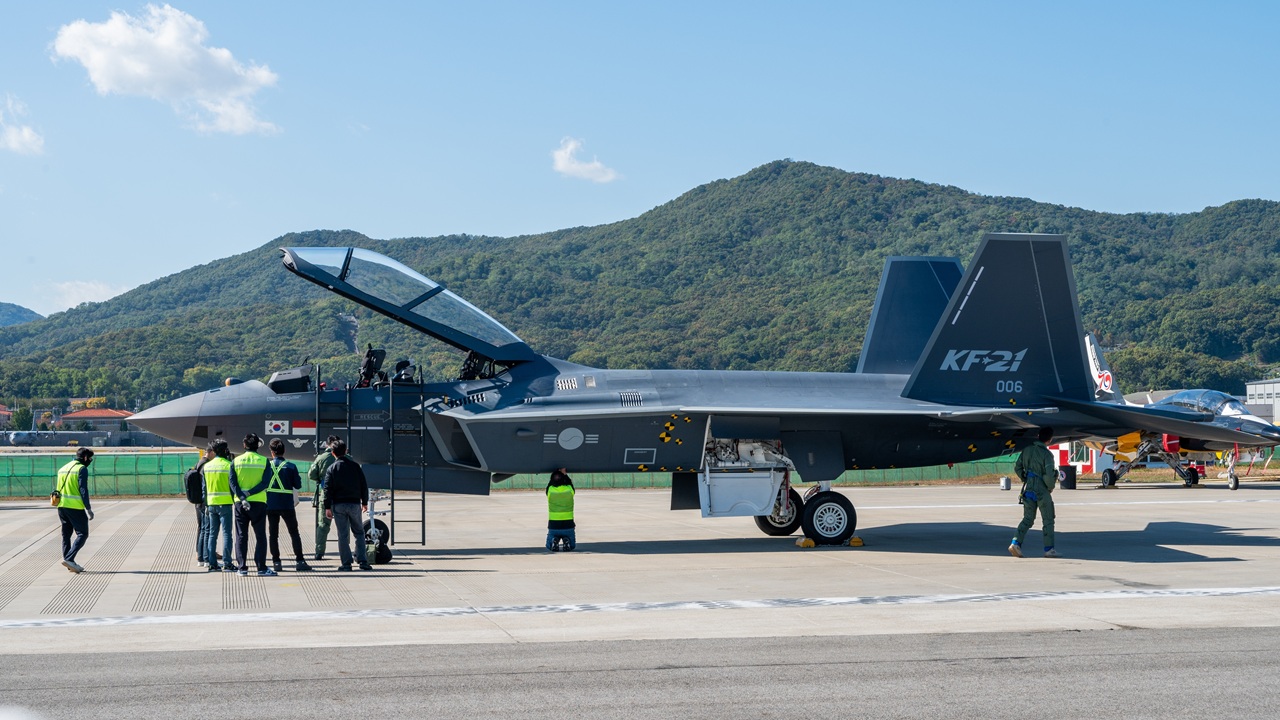 Topic: Air Warfare Blog Brand: The Buzz Region: Asia Tags: Aircraft, Fighter Jets, Hanwha, Jet Engines, KF-21 Boramae, and South Korea South Korea’s KF-21 Boramae Fighter Jet Is Now Fully Home-Grown January 9, 2026 By: Brandon J. Weichert
Share
South Korean defense conglomerate Hanwha has begun to build new jet engines for the Boramae fighter’s Block 3 variant, replacing General Electric.
South Korea is intent on becoming a competitive arms exporter. Their K2 Black Panther main battle tank (MBT) has already proven itself to be very popular on the world stage. Now Seoul is working to ensure that their new KF-21 Boramae fourth-generation-plus is competitive, too. Recently, the country invested $3.4 billion to fund the Advanced Aviation Engine Development Project, a new indigenously produced engine for the KF-21.
The firm that is leading the Advanced Aviation Engine Development Project is Hanwha Aerospace.
The KF-21 Boramae’s Specifications
- Year Introduced: 2022 (prototypes only)
- Number Built: 6 (prototypes only; 40 ordered)
- Length: 16.9 m (55 ft 4 in)
- Height: 4.7 m (15 ft 4 in)
- Wingspan: 11.2 m (36 ft 7 in)
- Weight:
- 11,800 kg (26,015 lb) empty
- 17,200 kg (37,920 lb) standard conditions
- 25,600 kg (56,400 lb) maximum takeoff weight
- Engines: Two General Electric F414-GE-400k turbofan; to be replaced by Hanwha turbofans in production variants
- Top Speed: ~2,140 km/h (1,330 mph) / Mach 1.8
- Range: Approx. 1,000 km (620 mi)
- Service Ceiling: Unknown; likely ~15,240 m (50,000 ft)
- Loadout: One 20mm M61A2 Vulcan autocannon; 10 hardpoints, 7,700 kg (17,000 lb) total payload
- Aircrew: 1-2
The KF-21 Boramae’s Missing Piece: Indigenous Engines
South Korea has outlined some key parameters for the success of the indigenization of the KF-21 engines. For starters, the new Hanwha-made turbofan jet engines must produce around 16,000 pounds of dry thrust, which is important for sustained combat flight. After that, the new engines are required to produce as much as 24,000 pounds of thrust with afterburner. This gives a much-needed boost for the plane when engaged in high-speed military operations.
Those requirements make the Hanwha turbofan jet engines for the KF-21 Boramae highly competitive when compared to international competitors. For instance, many Western fighter engines in the fourth-and-fifth-generation categories produce thrusts of roughly anywhere between 15,000 to a little more than 22,000 pounds per engine.
This ongoing program is a full lifecycle development project that Seoul intends to end with the new engine on a production aircraft. So, this is not merely a research project.
South Korea’s KF-21 Boramae is a 4.5-generation multirole fighter developed by Korea Aerospace Industries and is intended to replace the much older Republic of Korea Air Force jets currently in the country’s arsenal.
Currently, the KF-21s utilize foreign-made engines, such as the GE F414 turbofan engines under a license in South Korea. Although, the GE F414 series is an excellent jet engine for fighter planes, South Korea not only wants their indigenously made systems to compete on the global arms market, but they want to supply chain to be domestically sourced.
Having a domestic supply chain for these planes is key. After all, Seoul doesn’t want to share any prestige or profits with even their American allies unless they absolutely must.
There is, of course, more to this story than just protecting profits.
Why Supply Chains Matter More Than Alliances
South Korea sits at the bottom of a peninsula in which the northern portion, ruled from Pyongyang, is a vicious, nuclear-arming regime that has been at war with South Korea since 1950.
As North Korea’s military expands in capabilities and size, South Korea must match the North. More importantly, though, they cannot risk being cut off from their supply chains.
By relying exclusively, or almost exclusively, on domestically-sourced supplies, Seoul is ensuring that it will be that much harder for their enemies to physically blockade international supply chains…by simply not relying on those international supply chains.
So, the new engine is projected to eventually power the Block 3 version of the KF-21—giving the warplane true indigenous propulsion.
According to reports, South Korea intends to start formal development of this new engine by 2027. From there, throughout the 2030s, there will be prototype testing and certification. A decade thereafter, South Korea will integrate the Block 3 into the fleet of KF-21s.
Such moves further enhance South Korea’s deterrence toward North Korea and broader Indo-Pacific threats. And since indigenously produced fighter engines today are rare on the global market (the US, Russia, China, and a few European states produce such systems), Seoul is putting itself in a serious position alongside those foreign military aviation producers.
Real security changes are underway on the Korean Peninsula. Seoul is doing its best to respond to them by developing more advanced systems and making them available for sale on the global arms export market.
About the Author: Brandon J. Weichert
Brandon J. Weichert is a senior national security editor at The National Interest. Recently, Weichert became the host of The National Security Hour on America Outloud News and iHeartRadio, where he discusses national security policy every Wednesday at 8pm Eastern. Weichert hosts a companion book talk series on Rumble entitled “National Security Talk.” He is also a contributor at Popular Mechanics and has consulted regularly with various government institutions and private organizations on geopolitical issues. Weichert’s writings have appeared in multiple publications, including The Washington Times, National Review, The American Spectator, MSN, and the Asia Times. His books include Winning Space: How America Remains a Superpower, Biohacked: China’s Race to Control Life, and The Shadow War: Iran’s Quest for Supremacy. His newest book, A Disaster of Our Own Making: How the West Lost Ukraine is available for purchase wherever books are sold. He can be followed via Twitter @WeTheBrandon.
Image: Shutterstock / Ju Jae-young.
The post South Korea’s KF-21 Boramae Fighter Jet Is Now Fully Home-Grown appeared first on The National Interest.
Источник: nationalinterest.org