
«Данное сообщение (материал) создано и (или) распространено иностранным средством массовой информации, выполняющим функции иностранного агента, и (или) российским юридическим лицом, выполняющим функции иностранного агента»
 Topic: Land Warfare Blog Brand: The Buzz Region: Asia Tags: Armored Warfare, Hydrogen, K2 Black Panther, Main Battle Tanks, South Korea, and Tanks South Korea Is Reinventing the Tank—and Betting Big on Hydrogen Fuel January 13, 2026 By: Brandon J. Weichert
Share
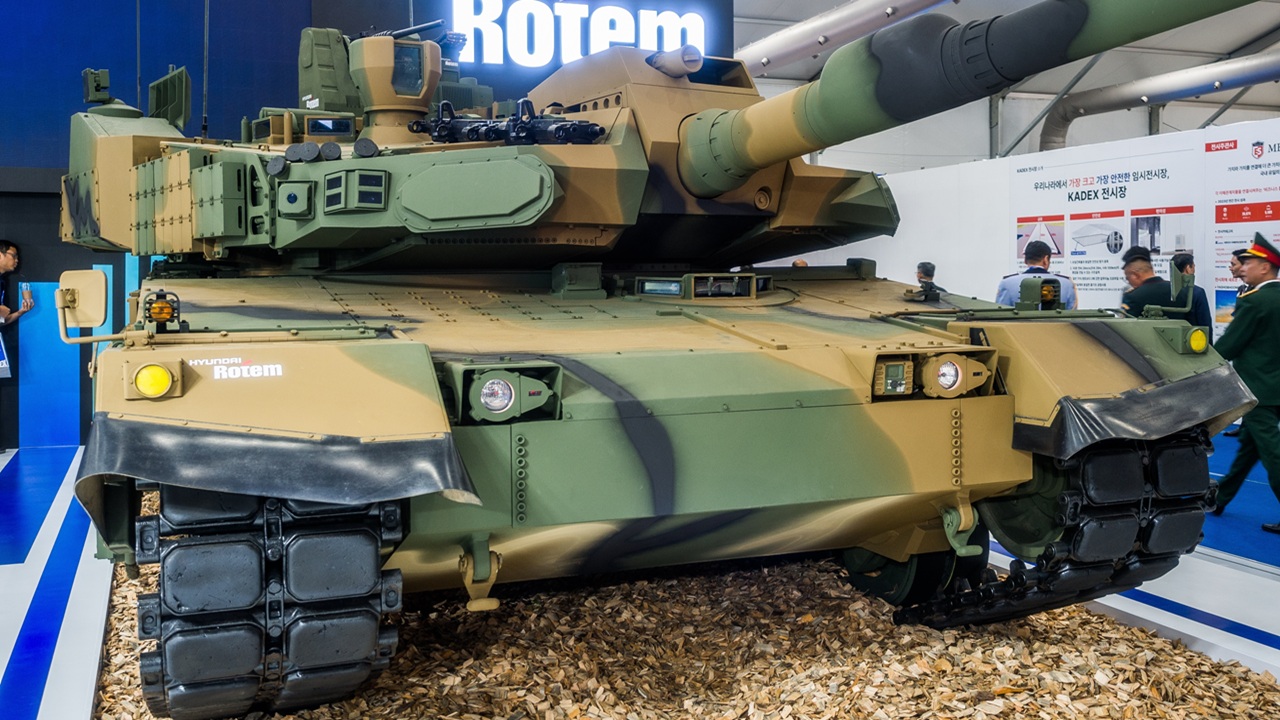
The upcoming K3 tank, scheduled to enter service in 2040, will be powered by hydrogen fuel cells—allowing for cleaner and quieter operation.
South Korea is committed to becoming both militarily self-sufficient and a dominant player in the global arms market. As North Korea rapidly develops its own capabilities, thanks largely to its newfound partnership with Moscow, and with the United States under President Donald Trump clearly skeptical about maintaining previous commitments to South Korea, Seoul must take matters into its own hands.
So, they are.
Meet the K3, South Korea’s Next-Generation Main Battle Tank
Enter the K3, South Korea’s next-generation Main Battle Tank (MBT) prototype that is designed to replace the current (and extremely popular) K2 Black Panther MBT. Hyundai Rotem, along with South Korea’s Agency for Defense Development (ADD) are jointly developing this next-generation prototype.
K3 incorporates next-level features into its baseline design that its designers believe will ensure the new MBT dominates a modern battlefield in which MBTs are increasingly made less valuable due to the presence of drone swarms and potent anti-tank weapons. As such, the K3 incorporates smooth, blended surfaces and angular shaping that more resembles an American stealth bomber than it does a traditional tank.
Hyundai Rotem and their partners in the ADD are trying to create a system that reduces radar, acoustic, and thermal signatures that would make it harder for enemies to detect—and even harder for those enemy drone swarms and anti-tank weapons to get a target lock on the K3 while in combat.
This system is still in the conceptual design phase. South Korea is anticipating full production of this innovative vehicle by around 2040.
The K3’s Proposed Specifications
As the K3 has not yet left the drawing board, its exact specifications have not been finalized yet. However, the tank is expected to have the following attributes:
- Year Introduced: Not yet introduced (planned ~2040)
- Number Built: 0 (still in development; planned units unknown)
- Length: Unknown
- Total Weight, Battle Ready: Around 55 tons
- Suspensions: Unknown
- Engine: Initially hybrid diesel-hydrogen systems; later full hydrogen capability
- Top Speed: 43-50 miles per hour (70-80 km/hr)
- Range: ~310 mi (500 km)
- Armament: 130mm smoothbore gun (larger than the 120mm standard on many Western tanks), with an autoloader and advanced fire control systems, and an unmanned turret
- Crew: 2–3 (driver, commander, and possibly a gunner)
The K3 Tank Will Be Powered by Hydrogen Fuel Cells
One of the most interesting aspects of the proposed new MBT is its engine. In the United States, the US military has experimented with hybrid engines for their tanks. Europeans have played with the concept of electric engines due to environmental concerns, though none have yet been embraced. Meanwhile, South Korea wants to give its new tank K3 MBT hydrogen fuel cells for propulsion.
In an age in which electric vehicles are all the rage for alternatives to traditional combustion vehicles, South Korea is clearly making the calculation that, by 2040, the infrastructure will be in place to support hydrogen fuel. This makes sense, since South Korea (as well as Japan) have been expressing interest in hydrogen fuel cells as an alternative to traditional combustion engines—believing that there are real limitations to electric power as alternatives to combustion engines.
The reason that South Korea might want to make a tank that is powered by hydrogen fuel cells would be to reduce noise and heat signatures. Fuel cells do not burn oil or emit noxious gases; their only output is water—straight-up H2O generated by combining the hydrogen with oxygen in the atmosphere. This would not only ensure the South Koreans create a more environmentally friendly system, but that this system is truly a silent, fast predator on the modern battlefield.
The K3 Is a Bold Concept for an Uncertain Future
This K3 MBT is still far off, of course. The strategic environment will be far different in 2040 (or later) than it is today. It is possible that this system, while very impressive on paper, is merely a proof of concept designed to stimulate the thoughts and minds of many of South Korea’s innovators.
Even if this tank is truly the system that Seoul has set upon as a replacement for the K2, we are quickly entering a world in which the Main Battle Tank, while still useful, faces a decreased role on the battlefield.
And then there’s the issue of the hydrogen engine alluded to above. Hydrogen storage, refueling infrastructure, and the associated costs and safety issues are not just hurdles to be overcome. They could be deal-killers, especially if hydrogen fuel cell technology is not widely embraced well before the K3 is set to make its debut.
Nevertheless, the K3 is an interesting concept and it could help South Korean designers work out some new concepts that will be instrumental in the way future tanks are developed.
About the Author: Brandon J. Weichert
Brandon J. Weichert is a senior national security editor at The National Interest. Recently, Weichert became the host of The National Security Hour on America Outloud News and iHeartRadio, where he discusses national security policy every Wednesday at 8pm Eastern. Weichert hosts a companion book talk series on Rumble entitled “National Security Talk.” He is also a contributor at Popular Mechanics and has consulted regularly with various government institutions and private organizations on geopolitical issues. Weichert’s writings have appeared in multiple publications, including The Washington Times, National Review, The American Spectator, MSN, and the Asia Times. His books include Winning Space: How America Remains a Superpower, Biohacked: China’s Race to Control Life, and The Shadow War: Iran’s Quest for Supremacy. His newest book, A Disaster of Our Own Making: How the West Lost Ukraine is available for purchase wherever books are sold. He can be followed via Twitter @WeTheBrandon.
Image: Shutterstock / Flying Camera.
The post South Korea Is Reinventing the Tank—and Betting Big on Hydrogen Fuel appeared first on The National Interest.
Источник: nationalinterest.org