

«Данное сообщение (материал) создано и (или) распространено иностранным средством массовой информации, выполняющим функции иностранного агента, и (или) российским юридическим лицом, выполняющим функции иностранного агента»
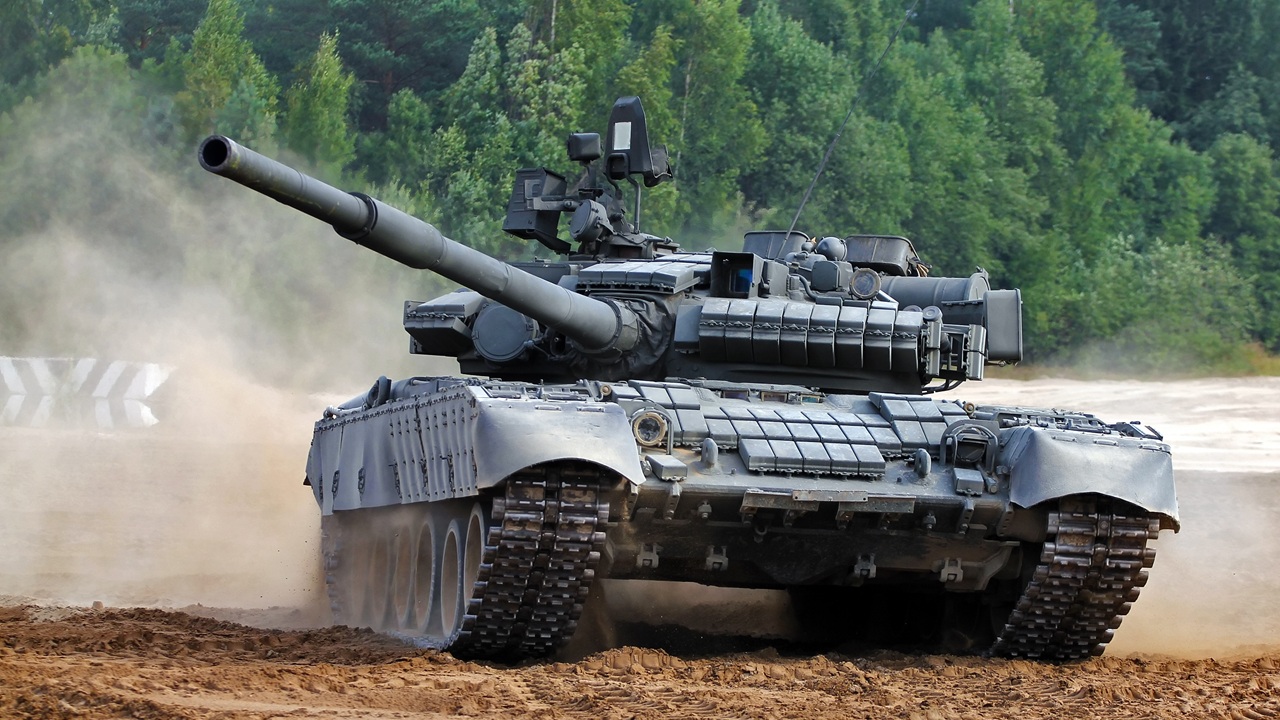 Topic: Land Warfare Blog Brand: The Buzz Region: Eurasia Tags: Armored Warfare, Drones, Main Battle Tanks, Russia, Tanks, and Ukraine War How Russian Tanks Are Adapting to War in Ukraine January 6, 2026 By: Brandon J. Weichert
Share
A new anti-drone system could shield Russia’s newest tanks from Ukrainian aerial attacks—though it is unclear if Russia can build the systems on time.
The weapons designers at Russia’s Uralvagonzavod industrial conglomerate have announced that the new iteration of the T-90M Main Battle Tank (MBT) will feature the Arena-M active protection system with an “anti-drone” mode.
This development is welcome news for the Russian Armed Forces. Drones have plagued both sides’ tank operations throughout the Ukraine War. Both the Russian and Ukrainian armies have struggled to develop effective counter-drone systems that can effectively protect their armor while in combat.
Understanding the Arena-M Anti-Drone System
Described as a “hard-kill system,” Arena-M uses radar to detect incoming attacks and then launches an explosive interceptor to destroy the incoming threat before it can become one. That interceptor explodes and creates a wall of fragments—like the flak shields of old—outside the vehicle employing the Arena-M system.
The system was originally designed to engage anti-tank projectiles within a 164-foot (50 meter) range and ignore slower moving objects and other ground clutter. Russian designers have finally cracked anti-drone systems and have incorporated them into the architecture of their Arena-M upgrade.
The anti-drone mode is a software upgrade which essentially gives the interceptor and radar hardware the speeds and various flight patterns of the drones. Whereas the original Arena-Ms were made to defend against fast moving anti-tank weapons, the new system addresses the fact that modern drone threats are not necessarily fast moving.
Throughout the Ukraine War, Russian military planners have experienced the threat of Ukraine’s drones that move at various speeds, are of various sizes, and can fly at different altitudes when on their attack approach to Russian tanks. Plus, drones can be made of plastic—which are not detectable by the Arena-M’s detection system—meaning that the interceptor missiles would not have even launched.
The Russian government disseminated a video on social media depicting the new system’s function. That video—shown in animation—illustrates how the upgraded Arena-M with anti-drone technology will be launched from a side compartment, distinct from the T-90’s turret mortars. That animation has led many experts to assess that the Arena-M counter-drone system represents an entirely new tank protection system from the existing Arena-M.
Defence-Post, an online industry publication, claims that “the Arena-M [anti-drone] system will be installed only on a revised version of the T-90M, sometimes referred to as the T-90M2, featuring an updated turret with an expanded rear section.”
That would comport with the physical attributes of the purportedly new Arena-M system mentioned above, with its counter-munition emanated from a side equipment compartment.
The Arena-M System Will Only Work if Russia Can Build It
Of course, if that is accurate, then it means that the new Arena-M counter-drone system would be finite in number and availability at the bloody frontlines of the Ukraine War.
There is only one problem for Russia: there are no T-90M2s in service today. Russia plans to build at least 10 of the vehicles over the course of this year. Military Watch Magazine recently reported that the Russian defense sector planned to produce the T-90M2s in early October 2025.
So, the Arena-M with the counter-drone system represents a significant advancement for Russian anti-tank protection systems. Yet, if they are confining the system only to T-90M2s—which have yet to be produced—then having such a system before the war ends might not be possible, and the Ukrainians will continue scoring hits on Russian armor with their drone swarms.
About the Author: Brandon J. Weichert
Brandon J. Weichert is a senior national security editor at The National Interest. Recently, Weichert became the host of The National Security Hour on America Outloud News and iHeartRadio, where he discusses national security policy every Wednesday at 8pm Eastern. Weichert hosts a companion book talk series on Rumble entitled “National Security Talk.” He is also a contributor at Popular Mechanics and has consulted regularly with various government institutions and private organizations on geopolitical issues. Weichert’s writings have appeared in multiple publications, including The Washington Times, National Review, The American Spectator, MSN, and the Asia Times. His books include Winning Space: How America Remains a Superpower, Biohacked: China’s Race to Control Life, and The Shadow War: Iran’s Quest for Supremacy. His newest book, A Disaster of Our Own Making: How the West Lost Ukraine is available for purchase wherever books are sold. He can be followed via Twitter @WeTheBrandon.
Image: Shutterstock / JetKat.
The post How Russian Tanks Are Adapting to War in Ukraine appeared first on The National Interest.
Источник: nationalinterest.org