
«Данное сообщение (материал) создано и (или) распространено иностранным средством массовой информации, выполняющим функции иностранного агента, и (или) российским юридическим лицом, выполняющим функции иностранного агента»
 Topic: Air Warfare Blog Brand: The Buzz Region: Asia Tags: Aerial Refueling, Boeing, India, Israel, South Asia, and Tanker Aircraft From Rust to Reach: India’s Air Refueling Revival January 23, 2026 By: Brandon J. Weichert
Share
India has ordered a handful of Boeing 767 planes to be converted into aerial tankers, with assistance from Israel.
India has finally approved the acquisition of six Boeing 767-derived aerial refueling tankers for the Indian Air Force (IAF). These refuelers were pre-owned Boeing 767 airframes that will all be converted into multirole tanker transport aircraft by Israel Aerospace Industries (IAI), in partnership with Hindustan Aeronautics Limited (HAL).
This is part of a larger modernization push the government of Prime Minister Narendra Modi has undertaken to both enhance the capabilities of the IAF as well as to expand them.
The Aviationist reports that the Indian government has granted the formal Acceptance of Necessity (AoN) and cleared the acquisition. In other words, the tanker deal is no longer something being talked about. It’s officially happening.
The deal is valued at around $1.1 billion. Reports suggest that the contract will be finalized by March 2026. Once it is, the IAF is expected to induct these planes by late 2029 or early 2030.
The Boeing 767 Was the Smart Choice for India
These pre-owned planes were originally built as airliners. They will be converted into Multi-Mission Tanker Transport (MMTT) aircraft.
IAI, the Israeli firm conducting the conversion, will ensure that the converted 767s will possess air-to-air refueling systems that are compatible with IAF fighter types. The IAF has a unique fleet of warplanes, ranging from Russian-made Su-30MKIs to Dassault Rafales, indigenously produced Tejas, for example.
India’s refurbished refuelers will be used for cargo, transport, and other utility roles as needed along with its primary mission as a refueler.
IAI and HAL: A Conversion Partnership That Works
IAI was attractive to the Indian government for multiple reasons—notably because the Israeli firm previously conducted similar conversions for the Colombian Armed Forces. At that time, IAI converted KC-767 aircraft into tankers. More importantly, the conversion will include around 30 percent of indigenous content provided by IAI’s on-the-ground partners in HAL.
So, this plays well not only with Modi’s modernization push for his military, but it also fits well into the government’s overall desire for indigenization of their equipment. And IAI is more than happy to oblige.
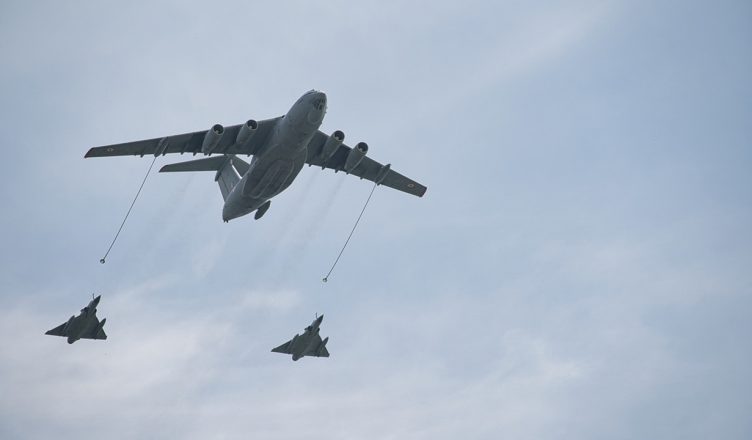
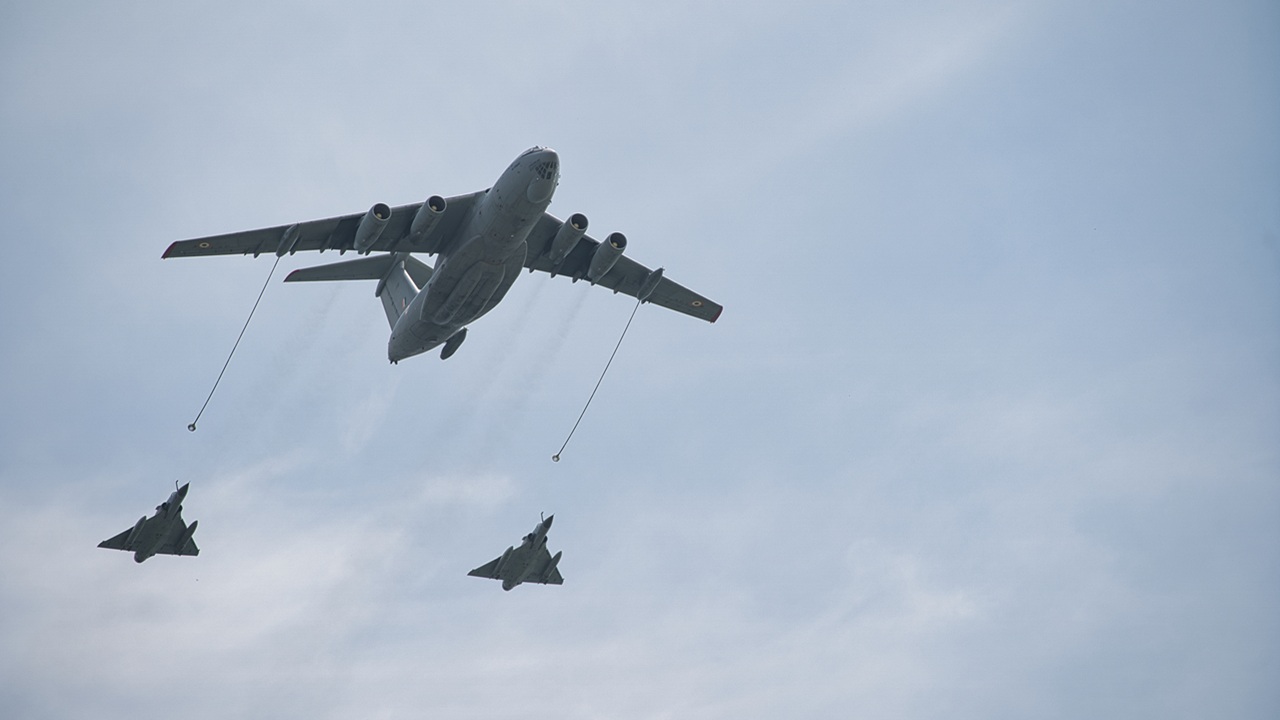
India had to move fast on this deal because their aerial refueling capability was withering on the vine. For instance, the IAF currently operates Russian-made Ilyushin II-78MKIs. These tankers are aging and their serviceability (and availability) have drastically declined. As these capabilities have declined, India’s aerial operations have been drastically reduced.
Without sufficient tanker support, long-range missions—notably those involving Rafales, Su-30MKIs, and Tejas warplanes—are quite limited. Given that India is expanding its strategic interests over the Indian Ocean and the wider Indo-Pacific to combat the Chinese threat to their north, reliable midair refuelers belonging to the Indian military itself are needed, if India is going to seriously challenge China’s growing presence in these expansive—and, in the case of the Indo-Pacific, distant—regions.
Over the years, India has tried to address what was clearly a deteriorating midair refueler decline. Initially, New Delhi wanted to procure Airbus A330s for conversion. Those deals, however, collapsed due to confusing procurement processes, massive bureaucratic delays, and cost disagreements. So India decided that the 767-conversion approach was the pragmatic, responsible middle path that properly balanced cost, capability, and timelines.
India’s Airpower Reset Has Finally Begun
And this deal couldn’t have come at a better time for India. In the wake of its war with Pakistan last year, which yielded decidedly mixed results for India’s air branch, serious reforms and modernizations were needed.
These new refuelers enable greater range as noted above, but they also allow for longer loiter time, all of which supports deeper strike missions—thereby extending the IAF’s overall lethality.
These midair refuelers will be essential building blocks for what New Delhi envisions as being a robust and reliable deterrent against both China and Pakistan. Without these planes, the IAF would be reliant on deteriorating Russian-made antiques to refuel them, and their operations would be greatly constrained.
About the Author: Brandon J. Weichert
Brandon J. Weichert is a senior national security editor at The National Interest. Recently, Weichert became the host of The National Security Hour on America Outloud News and iHeartRadio, where he discusses national security policy every Wednesday at 8pm Eastern. Weichert hosts a companion book talk series on Rumble entitled “National Security Talk.” He is also a contributor at Popular Mechanics and has consulted regularly with various government institutions and private organizations on geopolitical issues. Weichert’s writings have appeared in multiple publications, including The Washington Times, National Review, The American Spectator, MSN, and the Asia Times. His books include Winning Space: How America Remains a Superpower, Biohacked: China’s Race to Control Life, and The Shadow War: Iran’s Quest for Supremacy. His newest book, A Disaster of Our Own Making: How the West Lost Ukraine is available for purchase wherever books are sold. He can be followed via Twitter @WeTheBrandon.
Image: Shutterstock / Kowshi .L.
The post From Rust to Reach: India’s Air Refueling Revival appeared first on The National Interest.
Источник: nationalinterest.org