
«Данное сообщение (материал) создано и (или) распространено иностранным средством массовой информации, выполняющим функции иностранного агента, и (или) российским юридическим лицом, выполняющим функции иностранного агента»
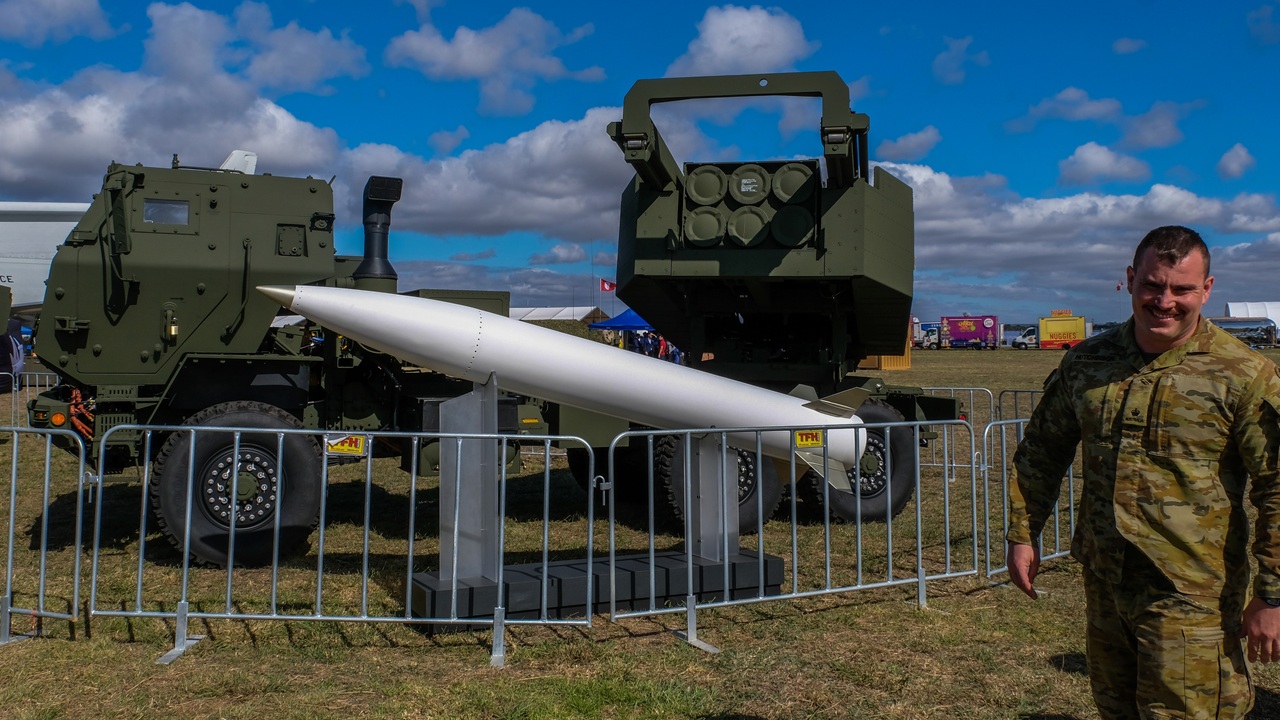 Topic: Air Warfare Blog Brand: The Buzz Region: Oceania Tags: Australia, China, First Island Chain, HIMARS, Indo-Pacific, People’s Liberation Army Navy, and United States Can Australia’s HIMARS Rocket Launchers Save the Pacific from China? January 8, 2026 By: Brandon J. Weichert
Share
HIMARS launchers are a serious threat to the People’s Liberation Army Navy—but Australia might have trouble adapting their land-based tactics for island warfare.
Although Washington’s recent National Security Strategy (NSS) memo watered down language on China’s threat to the United States, it did ostensibly reaffirm the United States’ commitment to what’s colloquially known as the “Island Chain Strategy” in Washington in order to contain Beijing’s regional ambitions.
American and allied strategists have divided the Indo-Pacific region into three distinct lines of defense. Three island chains, emanating from the shores of China out to Hawaii, have been identified as the zones of potential competition and conflict between America and China—with the first chain, stretching from Russia’s Kamchatka to Japan to Taiwan to the Philippines, as the priority.
The “First Island Chain” Strategy Is Unlikely to Work
As an aside, it’s important to note that whatever is written in these official strategy documents in Washington, they are not as important as the actions that President Donald Trump—who has demonstrated a reluctance to be pinned down by official doctrine—would actually take in the event of a geopolitical crisis between Beijing and Washington.
Of course, US strategic ambiguity on Taiwan dates back decades. But today, there is ample reason to believe that if Beijing called Washington’s bluff, the Americans would do very little to defend Taiwan. This is a problem because Taiwan is the linchpin of the First Island Chain. Dominate that, and you can dominate the rest of the First Island Chain—and project power reliably into the Second Island Chain beyond.
That Second Island Chain includes the northern end of Japan, the Mariana Islands (Guam, Northern Marianas), Palau, and the Federated States of Micronesia (FSM). It extends farther south to the Marshall Islands, Indonesia, and Papua New Guinea.
The Third Island Chain runs down from the Aleutian Islands through the Hawaiian Islands, American Samoa, Fiji, Tongo, and ending at New Zealand and Oceania.
China’s Expansion Has Triggered Australian Rearmament
Although the Chinese are focused primarily on the First Island Chain, their navy has in recent years been steadily expanding beyond the First Island Chain. Beijing is regularly sailing warships into the Second Island Chain, and has increased its geoeconomic influence in the Second and Third Island Chains.
In the wake of the COVID-19 pandemic, Canberra’s otherwise healthy relations with Beijing utterly broke down, prompting Australia to start preparing for possible conflict with the rising Asian hegemon.
While well-meaning, the Australians have engaged in what amounts to a haphazard arms buildup. But Canberra is trying to stand up its defenses as well as contribute to the combined defense of the Indo-Pacific area. Australia has purchased $705 million worth of the United States Army’s High Mobility Artillery Rocket Systems (HIMARS). This purchase includes resupply vehicles, trailers, training rockets, spares, communications equipment, and other key support vehicles.
Singapore and Taiwan have both purchased HIMARS systems for their own area defense. But the purchase by Canberra is significant in that it allows for Australia to expand its indirect fire reach from 12 to 249 miles (20-400 kilometers) when paired with Precision Strike Missiles (PrSMs). HIMARS would allow for Australia to forward deploy into the Second Island Chain and use these systems for anti-ship operations.
Australia already successfully tested their HIMARS during Exercise Talisman Sabre, indicating the Australian Army had successfully integrated HIMARS into their force structure and had real capability growth. The sale is part of a wider US effort to bolster the deterrence of their regional allies as tensions with China rise throughout the Indo-Pacific.
By acquiring enhanced long-range fires, like the HIMARS (paired with PrSM), Australia is ensuring they can conceivably hold Chinese naval forces at bay.
The US approval of the HIMARS sale to Australia deepens the US-Australia defense interoperability, while reflecting real strategic alignment amid the dramatically shifting geopolitical dynamics in the region.
“Shoot-and-Scoot” Tactics Don’t Work on Small Islands
Of course, it remains to be seen if HIMARS will be as effective in the maritime and island environments of the Indo-Pacific as they are in Europe and the Middle East.
After all, the entire concept of HIMARS is to “shoot and scoot,” launching a missile at the enemy and then quickly changing position before a counterattack can arrive. In an island setting, especially the islands of the Pacific, mobility will be limited—meaning that the Chinese could conceivably identify and attack HIMARS even if those HIMARS managed to get successful shots off before being destroyed.
Nevertheless, Australia’s purchase of HIMARS at such a scale is a real movement toward deterring potential Chinese aggression in the Second and Third Island Chains—a capability the US desperately needs to enhance, given the way in which the Chinese are expanding in the region and the Americans are increasingly feeling the need to pull back.
About the Author: Brandon J. Weichert
Brandon J. Weichert is a senior national security editor at The National Interest. Recently, Weichert became the host of The National Security Hour on America Outloud News and iHeartRadio, where he discusses national security policy every Wednesday at 8pm Eastern. Weichert hosts a companion book talk series on Rumble entitled “National Security Talk.” He is also a contributor at Popular Mechanics and has consulted regularly with various government institutions and private organizations on geopolitical issues. Weichert’s writings have appeared in multiple publications, including The Washington Times, National Review, The American Spectator, MSN, and the Asia Times. His books include Winning Space: How America Remains a Superpower, Biohacked: China’s Race to Control Life, and The Shadow War: Iran’s Quest for Supremacy. His newest book, A Disaster of Our Own Making: How the West Lost Ukraine is available for purchase wherever books are sold. He can be followed via Twitter @WeTheBrandon.
Image: Shutterstock / Alex Bogatyrev.
The post Can Australia’s HIMARS Rocket Launchers Save the Pacific from China? appeared first on The National Interest.
Источник: nationalinterest.org