

«Данное сообщение (материал) создано и (или) распространено иностранным средством массовой информации, выполняющим функции иностранного агента, и (или) российским юридическим лицом, выполняющим функции иностранного агента»
 Topic: Artificial Intelligence (AI), Critical Minerals, and Oil and Gas Blog Brand: Techland Region: Americas, Asia, Eurasia, and Middle East Tags: China, Great Power Competition, Helium, Iran War, North America, Nvidia, Qatar, Russia, Samsung, SK Hynix, South Korea, Taiwan, TSMC, and United States Russia’s Helium Card in the AI Arms Race April 7, 2026 By: Fyodor Dmitrenko
Share
The Iran War knocked out a third of global helium. China barely flinched. What does that tell us about who’s actually winning the industrial contest behind artificial intelligence?
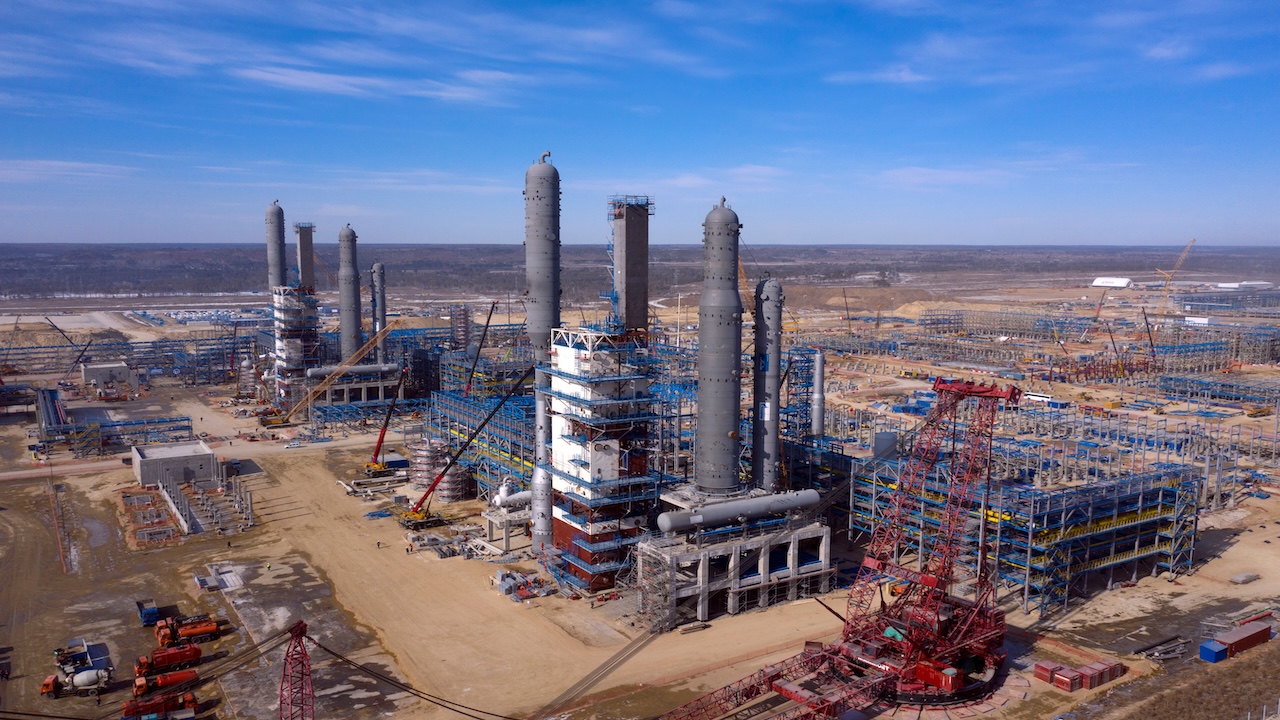
About 40 kilometers from where Russia meets China, in a stretch of the Far East that most Americans couldn’t find on a map, Gazprom runs a gas processing plant near a town called Svobodny. Methane separation, ethane extraction, propane—mundane petrochemical stuff. Nobody in Washington cares. What they should care about: Russia’s Amur gas processing plant also houses what’s becoming the world’s largest helium production complex. Sixty million cubic meters a year at full tilt. Roughly what Qatar used to produce before Iranian missiles wrecked Ras Laffan.
Why does that matter? Not because of helium prices, or MRI shortages, or any of the angles that have already been covered. It matters because helium—this weird, noble gas that most people only encounter in party balloons—has quietly become a load-bearing element in the great-power contest over artificial intelligence(AI). And on that score, the Iran War isn’t hurting the countries you’d expect.
Where Do AI Chips Actually Come From?
Ask people in Washington about competing with China on AI, and you’ll hear about export controls, Nvidia’s latest GPU architecture, maybe how many H100s got smuggled through Singapore. All fair. Here’s what you won’t hear: where those chips physically get manufactured.
Nvidia doesn’t make its own chips. TSMC does, in Taiwan, at fabrication nodes measured in single-digit nanometers. High-bandwidth memory—the component that turns a GPU into an AI accelerator? Samsung and SK Hynix build that, both based in South Korea. So America’s entire AI superscaling effort—the hundreds of billions Microsoft, Google, Meta, and Amazon are pouring into data centers—funnels through three companies in two Asian democracies.
All three need helium. Not “would prefer to have helium”—need it, with no workaround. ASML’s extreme ultraviolet (EUV) lithography machines, which cost upward of $150 million each, can’t operate without helium cooling their extreme ultraviolet light sources. Wafer processing demands it for vacuum integrity. Contaminant flushing at the atomic level? Helium again. And here’s the kicker: per-wafer consumption keeps climbing, because each new EUV patterning step at smaller nodes gobbles more gas. Only goes one direction.
When Ras Laffan went dark on March 2, roughly a third of the world’s helium vanished from the market. So the question wasn’t if chipmaking would feel it. It was who’d feel it worst.
Seoul Got Hammered. Beijing Didn’t.
Turns out the answer is grimly lopsided. South Korea—where Samsung and SK Hynix produce the memory chips powering every AI training cluster on the planet—got nearly 65 percent of its helium from Qatar last year. Taiwan’s TSMC drew heavily on Qatari supply too. Japan hedged better, sourcing about half its helium from American producers. Seoul and Taipei, though? They’re the ones who got caught out.
Both Samsung and SK Hynix have talked up holding months of reserves. I’d discount that. Helium boils off continuously—even inside specialized cryogenic containers cooled near absolute zero, you’ve got maybe 35 to 48 days before losses get ugly. You can’t warehouse it like crude oil; you can’t stack barrels in a cave in Louisiana and wait. What’s actually on hand at a given fab site, ready to feed into machines? A week’s worth. Maybe. Everything beyond that depends on fresh deliveries—and from Qatar, those aren’t coming.
Now pivot to China. Different picture entirely. Russia shipped more than half of China’s helium imports through 2025, volumes up 60 percent year-on-year, at a price about a third cheaper than what Qatar charged. December was wild—Russian shipments to China more than doubled versus the 12 month average, which tells you Amur’s second helium production line had ramped aggressively. A third line should come online sometime this year. All of it moves overland: pipelines, trucks out of a logistics hub near Vladivostok. No Strait of Hormuz. No cryogenic containers threading through a naval combat zone. Entirely different supply geometry.
And Beijing hedged further. Domestic Chinese helium capacity—still tiny, covering maybe five percent of demand—has been growing fast. Guangdong Huate Gas cracked mass production of semiconductor-grade helium at 99.9999 percent purity and got ASML to certify it. Not some laboratory demo. A production-qualified supplier for the hardest lithography specs in existence. Meanwhile—and this part gets less attention—Chinese firms have been re-exporting Russian helium across Asia, routing sanctioned molecules through Shenzhen and Hong Kong to third-party buyers. A middleman operation, plain and simple.
How Helium Hits the AI Buildout
People frame the US–China AI competition around models—who builds GPT-next, who’s got the biggest training run, who deploys first. Fine. But models are trained on GPU clusters. GPU clusters are assembled from chips. Chips get manufactured in fabs that consume helium at every production step. Choke off helium; chip output drops. Chip output drops; training runs slip. An unbroken chain from a gas field in Qatar to a delayed model release in Silicon Valley.
Already visible in the numbers: Dynamic Random Access Memory (DRAM) and High-Bandwidth Memory (HBM) prices roughly doubled in Q1 2026. TSMC’s advanced packaging capacity for Nvidia’s Blackwell GPUs—already sold out through mid-year before any of this started. Every wafer starts with Samsung or SK Hynix skips because of helium rationing, which turns into a high-bandwidth memory stack that doesn’t exist in three months. Fabs will protect AI hardware first and ration consumer chips instead—IDC’s already forecasting a 13 percent smartphone shipment drop—but even with triage, total throughput contracts. Fewer chips, later delivery, higher price tags.
Does China face the same physics? Sure—helium is helium. Exposure is different, though. Chinese mature-node fabs, which cranked out about a third of the world’s trailing-edge chips in 2023, can pull helium through Amur without skipping a beat. Beijing’s bleeding-edge AI chip program? Held back less by gas supply than by ASML export controls—a constraint with zero connection to what’s happening in the Gulf. Perversely, the helium crunch is a bigger headache for countries making the best chips than for the one scrambling to catch up.
I’ll put it bluntly. American hyperscalers are betting hundreds of billions on an AI infrastructure buildout that runs through two countries—South Korea and Taiwan—whose helium supply just got wrecked by a war America launched. Meanwhile, China’s buying cut-rate helium from a Russian plant partly bankrolled by Chinese lenders, piped in along a route American sanctions can’t touch. A screenwriter would get notes for making the irony too heavy-handed.
Why Amur Changes the Map
What makes Amur strategically important isn’t just capacity—though at full output it would rival Qatar. It’s the architecture. Amur sits on Gazprom’s Power of Siberia pipeline, a 30 year supply deal with China National Petroleum Corporation. Helium comes out as a byproduct of eastbound gas flows. As long as Russian gas keeps moving toward China—and nobody expects it to stop, given it’s a growing slice of China’s energy diet—helium rides along. A logistics center near Vladivostok adds a sea-export option for Southeast Asian, Indian, and other buyers.
There is a rocky history, though. A 2021 fire took the plant offline for twenty months. Western sanctions after the Ukraine invasion made spare parts procurement miserable. Gazprom still managed to bring two of three helium lines to full capacity by late 2023—reportedly without any Western technical help. Line three is under construction. Once it’s running, Russia’s annual helium production will approach 80 million cubic meters, leapfrogging America and reshaping global supply in ways the current crisis only accelerates.
Pricing tells the story. Russian helium went for about $310 per thousand cubic feet in 2025; Qatari volumes cost $470. Moscow’s undercutting everyone, and it can afford to—Amur’s helium economics ride piggyback on a pipeline whose capital costs got sunk a decade ago. Chinese buyers get cheap gas from a desperate neighbor. Russia gets revenue, and a deepening relationship Beijing won’t jeopardize. Neat arrangement—if you’re sitting in Moscow or Beijing.
An Irony Washington Can’t Ignore
Three years of trying to kneecap Russia economically and box in China technologically—and on helium, both efforts are smashing into each other. Sanctions shoved Russian helium out of European and American markets, straight toward China, handing Beijing a supply cushion that the Iran War now makes priceless. And the Iran War itself? Triggered by a war in which Washington is belligerent, disrupting helium to the very allied fabs that underpin American AI supremacy.
Should we overstate the danger? No. Chinese advanced-chip yields remain awful. Frontier AI models out of Beijing still lag behind American ones. ASML’s High-NA EUV machines aren’t shipping to China. Great-power contests, though, don’t get decided in a quarter. They turn on sustained industrial stamina across years and decades. Right now—March 2026—if you ask whose AI compute supply chain handles disruption better, Washington’s or Beijing’s, the honest answer isn’t reassuring.
Worth remembering a pattern here. Back in 2022, Russia’s Ukraine invasion disrupted semiconductor-grade neon—half of global supply came from two companies in Odesa and Mariupol—and prices went vertical, up 5,000 percent. The chip industry adapted, diversified, and shrugged it off. The lesson—obscure industrial gases can choke the most critical manufacturing on earth—got filed away and forgotten. Helium is that same vulnerability at bigger scale, with an uglier geopolitical twist: this time around, a strategic competitor benefits from the disruption. Neon didn’t hand an advantage to anyone. Helium hands one to China.
An arms race in AI has a materials base. That material base has geography. And a gas nobody thinks about is quietly redrawing whose map looks better.
About the Author: Fyodor Dmitrenko
Fyodor Dmitrenko is a geopolitical analyst and researcher specializing in sustainable development, energy policy, and governance on the Eurasian continent. He is affiliated with Sciences Po Paris, where he conducts research under the supervision of Professor Tatiana Mitrova. He has contributed articles on developments in energy markets and international trade flows at Reuters News Agency’s CIS office and for emerging think tanks such as India’s TheGeostrata and the Paris section of the French-MFA-affiliated Andalus Committee, which deals with EU-global south relations. He has also engaged with leaders in the sustainable development field at the Guiyang Ecological forum as a Sciences Po delegate to the Tsinghua Global Youth Dialogue, and interviewed policy makers such as former Brazilian central bank head Gustavo Franco and former Swiss President Simonetta Sommaruga as the Sciences Po delegate to the Warwick Economic Summit.
The post Russia’s Helium Card in the AI Arms Race appeared first on The National Interest.
Источник: nationalinterest.org