

«Данное сообщение (материал) создано и (или) распространено иностранным средством массовой информации, выполняющим функции иностранного агента, и (или) российским юридическим лицом, выполняющим функции иностранного агента»
 Topic: Air Warfare Blog Brand: The Buzz Region: Asia Tags: Aircraft, East Asia, Electronic Warfare, Japan, and Japan Air Self-Defense Force (JASDF) The ‘World’s Ugliest Plane’ Took Flight over Japan Last Week March 24, 2026 By: Harrison Kass
Share
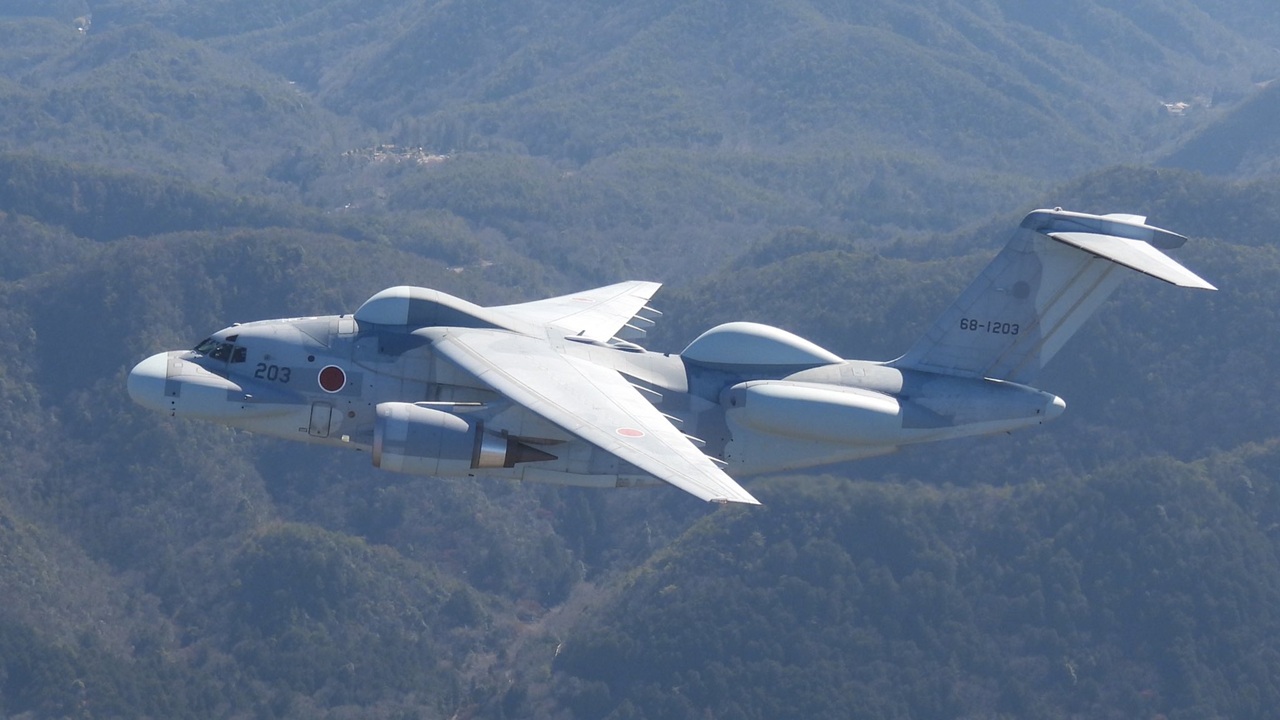
The nose of the EC-2 “Platypus” is filled with cutting-edge electronic equipment—giving it a decidedly non-aerodynamic appearance.
The Japan Air Self-Defense Force (JASDF) has a new electronic warfare jet, the Kawasaki EC-2, which has gained some notoriety around the world for its ungainly appearance. Built to conduct standoff electronic warfare missions and capable of disrupting enemy radar, air defense systems, and communications from outside of theater range, the EC-2 is, looks aside, a strategic asset. Development began in 2021 and $260 million was allocated to the program in the FY2025 budget, suggesting that the EC-2 is an important part of the JASDF’s future.
Why Does the EC-2 “Platypus” Plane Look So Weird?
The EC-2 was converted from the C-2 military transport, an indigenous Japanese twin-jet cargo plane that offered excellent payload capacity, flight performance, and cost efficiency. Powered by two GE CF6 turbofan engines, the C-2 sits between a C-17 Globemaster III and a C-130 Hercules with respect to its capability.
But where the EC-2 stands apart in particular is with respect to its aesthetics. With a distinctive bulged nose radome, two large fairings on top of the fuselage, and two more on the rear sides, the EC-2 is bizarre at first glance. These incongruous features are added for the purpose of conducting electronic warfare.
Replacing the retired Kawasaki EC-1 (converted from the older C-1 transport), the EC-2 carries over some equipment from its predecessor, including the J/ALQ-5 electronic countermeasures system. But while just one EC-1 was ever built, Japan has plans to buy four EC-2s.
And a related SIGINT (signals intelligence) variant, the RC-2, has been operational since 2020. The two aircraft are expected to work together, with the RC-2 mapping enemy emitters in peacetime, and the EC-2 targeting those same emitters in conflict.
Why Does Japan Need New Electronic Warfare Planes?
The timing of the JASDF’s standoff EW capability expansion is not a coincidence. Japan faces growing military pressure from China, North Korea, and Russia in what is becoming the most strategically important corner of the world. China in particular poses a problem for Japan as the two have various territorial disputes.
As China continues to increase its assertiveness, and expands its military capabilities in tandem, Japan will seek to follow suit. North Korea, too, presents a challenge, given its habit of conducting ballistic missile tests near and over Japan. Accordingly, the EC-2 is part of a broader $3.2 billion Japanese investment in electromagnetic and intelligence capabilities. Japan has also explored arming the C-2 transport with standoff missiles, with $25 million investing in researching the project for FY2023.
While visually distinct, the EC-2 does have peers:
- United States: The US Air Force flies the EA-37B Compass Call, based on the Gulfstream G550 business jet, the EA-37B’s role is to disrupt enemy command and control communications, radars, and navigation systems.
- Australia: The Royal Australian Air Force flies the MC-55A Peregrine, also based on the Gulfstream G550. Designated an ISR and EW aircraft, the MC-55A is highly flexible and capable of networking with other systems, including the F-35A, E-7A, surface vessels, and ground forces.
Japan’s EC-2 fits a pattern of growing EW-capable aircraft, all fielded by countries whose primary security concern is the rise of China. So expect the EC-2, and its cousins the EA-37B and MC-55A, to be relevant to the most consequential theater of geopolitics in the coming decades.
About the Author: Harrison Kass
Harrison Kass is a senior defense and national security writer at The National Interest. Kass is an attorney and former political candidate who joined the US Air Force as a pilot trainee before being medically discharged. He focuses on military strategy, aerospace, and global security affairs. He holds a JD from the University of Oregon and a master’s in Global Journalism and International Relations from NYU.
The post The ‘World’s Ugliest Plane’ Took Flight over Japan Last Week appeared first on The National Interest.
Источник: nationalinterest.org