

«Данное сообщение (материал) создано и (или) распространено иностранным средством массовой информации, выполняющим функции иностранного агента, и (или) российским юридическим лицом, выполняющим функции иностранного агента»
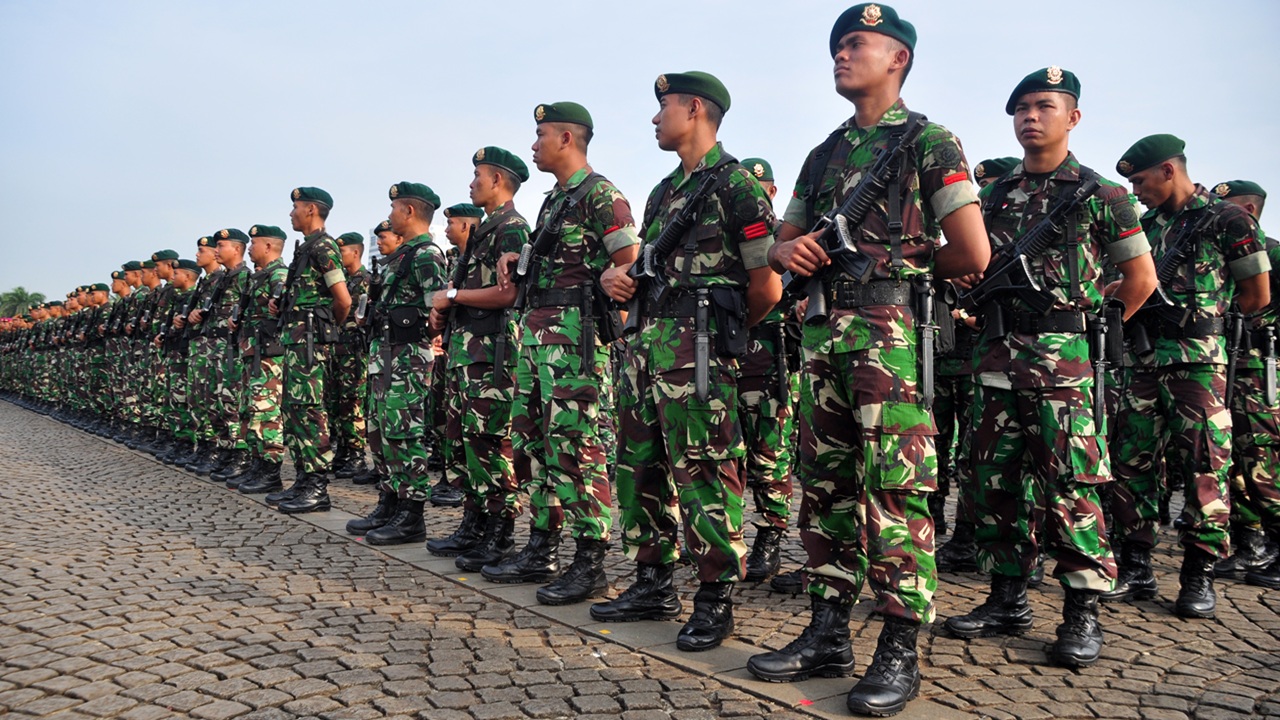
Indonesian troops from various units pictured on parade at the National Monument in Jakarta in April 2015. Indonesia is Southeast Asia’s largest military power. (Shutterstock/Dani Daniar)
Topic: Air Warfare, and Naval Warfare Blog Brand: The Buzz Region: Asia Tags: ASEAN, China, Indonesia, South China Sea, and Southeast Asia Is Indonesia the Next Rising Power in the Indo-Pacific? March 1, 2026 By: Harrison Kass
Share
Indonesia is seeking to modernize its military amid growing regional challenges—but is hamstrung by its paltry defense budget.
Indonesia is the world’s largest island state, occupying 17,000-plus islands scattered across southeast Asia and Oceania. The Indonesian archipelago sits astride critical sea lanes including the Malacca, Sunda, and Lombok Straits. With a massive population of 275 million and a steadily growing economy, the Indonesian military is tasked with defending a vast maritime territory and air space spanning thousands of miles. Structured for internal stability and regional deterrence, Indonesia’s military faces modernization and geographic challenges in an era of great-power competition.
Indonesia’s Strategic Context
Indonesia controls sea lanes that are vital to global trade, positioned between the Indian Ocean and South China Sea. In foreign affairs, Indonesia maintains strategic non-alignment, balancing its relations with China, the United States, Australia, and its ASEAN neighbors. Indonesia’s primary strategic objective is to preserve its own sovereignty, avoid entanglement, and maintain territorial integrity across dispersed islands. An intricate threat environment (both internal and external) complicates these objectives.
Externally, Indonesia’s tensions with China in the South China Sea are a complicating factor. Its claims of an exclusive economic zone (EEZ) in the southern part of the sea overlaps with China’s own expansive “nine-dash line” claim near Natuna Islands. The Chinese Coast Guard vigorously defends Beijing’s claims across the South China Sea, putting it into regular contention with Indonesia. Another source of external friction is regional arms competition between Singapore, Australia, Vietnam, and other smaller coastal states. Internally, Indonesia is faced with separatist movements, ideologically motivated terrorism, and frequent natural disaster response requirements due to its dispersed population, inclement weather, and relatively unsophisticated construction standards.
The Indonesian Military Is the Largest in Southeast Asia
Indonesia’s military, the Tentara Nasional Indonesia (TNI) consists of an Army (300,000 personnel), Navy (65,000), and Air Force (30,000), plus reserve and paramilitary elements—making it the largest military force in Southeast Asia, followed by Vietnam and Thailand. Within the Indonesian military, the Army is the largest and most prestigious branch, focused on territorial defense and internal security.
For equipment, the Army relies on Leopard 2A4 main battle tanks (100+) and light armored vehicles. Jakarta has also invested heavily in artillery modernization. Indonesia’s primary armed conflicts have been internal, against secessionist and terrorist groups, and the Army is primarily structured for counterinsurgency operations rather than foreign wars.
The Indonesian Navy is critical given Indonesia’s archipelagic geography. Its assets include several frigates, 20-plus corvettes, 20-plus patrol vessels, and four operational Type 209 variant submarines. The Navy also operates amphibious ships and LPDs for inter-island mobility.
The Navy has only limited blue-water capability, and maintenance constraints limit operational capacity further. Still, the Navy is tasked with sea lane security, EEZ enforcement, and deterring the Chinese Coast Guard around Natuna. Indonesia is working to expand its submarine fleet and their shipbuilding abilities.
The Indonesian Air Force is the smallest of the three service branches. It operates an eclectic mix of American, Russian, and non-aligned aircraft, including 30-plus F-16s, 16 Su-27/30s, three Dassault Rafales, 21 Hawk 209s, 13 T-50i Golden Eagles, and 13 Super Tucanos. Indonesia has limited integrated IADS, with key gaps in early warning and long-range strike capabilities. It is working to modernize their air force, including through the recent purchase of a handful of Rafale aircraft. Negotiations are underway with Washington to buy the F-15EX Eagle II, which if completed would further augment Indonesia’s strength in the air.
Indonesia’s Small Military Budget Is a Major Constraint
On paper, Indonesia’s military appears to have major prospects for growth. The country’s large population, favorable geography, and ongoing need to stand up to China in the South China Sea all point toward greater investments in the country’s defense capabilities. However, Indonesia is also a developing country with limited government resources, and has prioritized economic growth over defense investments. So far, its defense budget remains modest, at roughly 1 percent of GDP.
Moving forward, Indonesia will face three enduring challenges. Its geography, while advantageous in some ways, is a constant in others. The burden of defending a dispersed geography will continue to complicate Indonesia defense planning. Budget constraints, too, will limit Indonesia’s modernization pace. Finally, geopolitical concerns will restrict Indonesia’s freedom of action abroad; as great-power competition heats up, it will continue to avoid overt alignment with either China or the West.
In the future, Indonesia will likely strengthen its maritime abilities, expand its air power, and invest in coastal defenses. But don’t expect Indonesia to focus on becoming an expeditionary power; its aims are still regional, with a focus on defending its own sovereignty first.
About the Author: Harrison Kass
Harrison Kass is a senior defense and national security writer at The National Interest. Kass is an attorney and former political candidate who joined the US Air Force as a pilot trainee before being medically discharged. He focuses on military strategy, aerospace, and global security affairs. He holds a JD from the University of Oregon and a master’s in Global Journalism and International Relations from NYU.
The post Is Indonesia the Next Rising Power in the Indo-Pacific? appeared first on The National Interest.
Источник: nationalinterest.org