

«Данное сообщение (материал) создано и (или) распространено иностранным средством массовой информации, выполняющим функции иностранного агента, и (или) российским юридическим лицом, выполняющим функции иностранного агента»
 Topic: Air Warfare Blog Brand: The Buzz Region: Americas, Eurasia, and Europe Tags: Aircraft, Cold War, F-16 Fighting Falcon, F-4 Phantom II, F-5 Tiger, Fighter Jets, MiG-15, Mig-17, MiG-19, Mig-21, Mirage F-1, Mirage III, Soviet Union, Su-27 Flanker, and United States The 10 Most Commonly Exported Fighter Jets January 26, 2026 By: Harrison Kass
Share
One nation historically dominated the fighter jet export market: the Soviet Union, whose simple, rugged aircraft spread widely across the developing world during the Cold War.
Fighter aircraft have long been one of the most politically consequential export items in the world. The transaction extends far beyond dollars and cents—touching alliances, training pipelines, logistics, and long-term dependency. To that end, some aircraft have been successful on the export market not necessarily because they were better aircraft, but because they were aligned with a variety of peripheral factors at exactly the right time.
Ten aircraft in particular have helped to define the historical export market. Honorable mentions, not listed, deserve acknowledgment, too: China’s J-7 (a MiG-21 derivative), the Soviet Union’s MiG-23, the British-made Hawk trainer/light attack aircraft, and the up-and-coming (at least in terms of export quantity) F-35 Lightning II. But the following are ranked strictly by export volume—a grouping of aircraft that shaped air forces and geopolitics for decades.
10. Mirage F1 (France)
Exports: ~700
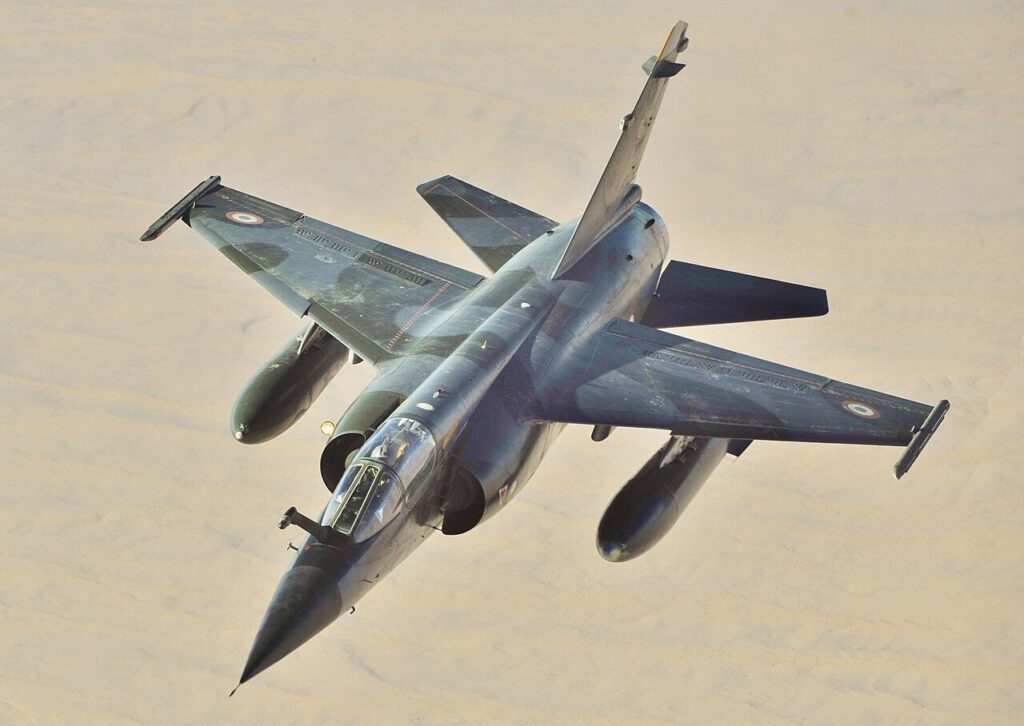 A French Air Force Mirage F1 returns to its mission after receiving fuel from a U.S. Air Force KC-10 Extender from the 908th Expeditionary Air Refueling Squadron while flying over Afghanistan in support of Operation Enduring Freedom, Nov. 25, 2010. KC-10s deliver critical air refueling support to numerous joint and coalition receiver aircraft. (U.S. Air Force Photo/Staff Sgt. Eric Harris)
- Year Introduced: 1973
- Number Built: ~730
- Length: 49 ft 11 in (15.2 m)
- Wingspan: 27 ft 7 in (8.4 m)
- Weight (MTOW): ~35,500 lb (16,100 kg)
- Engines: One SNECMA Atar 9K-50 turbojet
- Top Speed: 1,453 mph (2,338 km/h) / Mach 2.2
- Range: ~2,050 mi (3,300 km) ferry
- Service Ceiling: ~65,000 ft (19,800 m)
- Loadout: Cannon; air-to-air and air-to-ground ordnance on 7 hardpoints
- Aircrew: 1
The Mirage F1 was a quiet export success, filling a gap between lightweight interceptors and heavy multirole fighters. After debuting in the early 1970s, the F1 offered solid performance with respectable range and a conventional swept-wing design that appealed to air forces concerned with the relatively exotic delta-wing configuration. Widely exported across Africa, the Middle East, and Latin America, the F1 was often tasked with operating in austere conditions. While never iconic, the F1 was dependable—and is still in service today in a handful of nations, including Morocco, Libya, and Iran.
9. Sukhoi Su-27 (USSR/Russia)
Exports: 1,200+ (including derivatives)
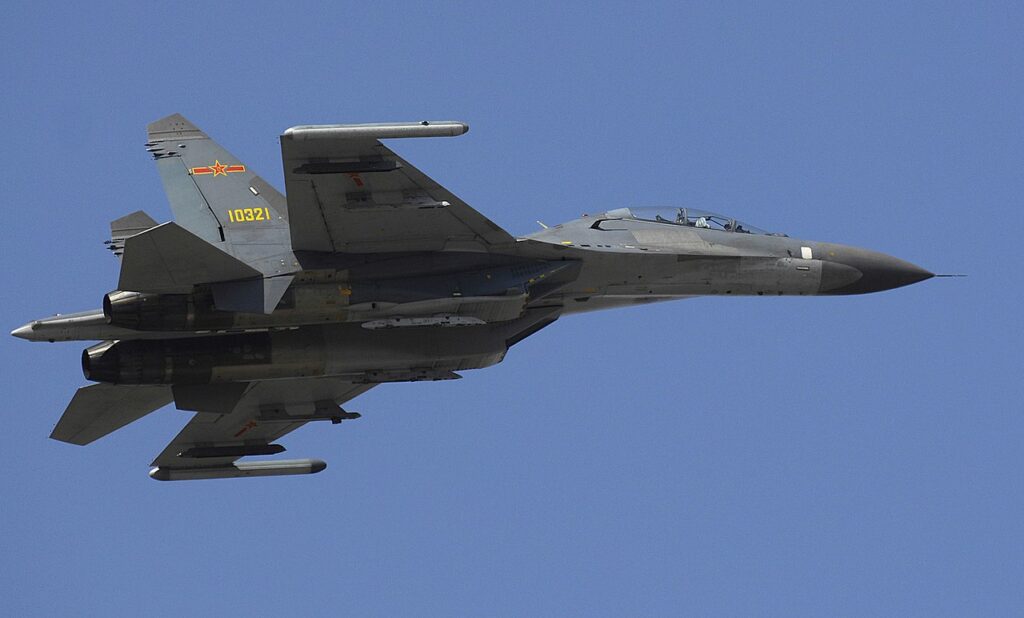 A Chinese Su-27 Flanker fighter makes a fly by while the Chairman of the Joint Chiefs of Staff, Marine Gen. Peter Pace, visits with members of the Chinese Air Force at Anshan Airfield, China, March 24, 2007. (Defense Dept. photo by U.S. Air Force Staff Sgt. D. Myles Cullen)
- Year Introduced: 1985
- Number Built: ~680 (Su-27 proper; excludes derivatives)
- Length: 71 ft 10 in (21.9 m)
- Wingspan: 48 ft 3 in (14.7 m)
- Weight (MTOW): ~73,850 lb (33,500 kg)
- Engines: Two Saturn AL-31F turbofans
- Top Speed: 1,553 mph (2,500 km/h) / Mach 2.35
- Range: ~2,200 mi (3,530 km) ferry
- Service Ceiling: ~59,000 ft (18,000 m)
- Loadout: 30mm cannon; up to ~17,600 lb of weapons
- Aircrew: 1
The Su-27 family represents the Soviet, and later Russian, approach to high-end fighter exports—taking on fewer customers, but ultimately offering a more capable aircraft. Designed as a long-range air superiority fighter, the Su-27 proved maneuverable, with impressive endurance and payload.
Far from falling into obsolescence after the end of the Cold War, the Su-27’s exports expanded to China, India, and other South Asian countries, while also spawning license builds and derivatives. While never cheap, the Su-27 sold well because it offered near-top-tier performance without Western political barriers.
8. Mirage III (France)
Exports: 1,300+
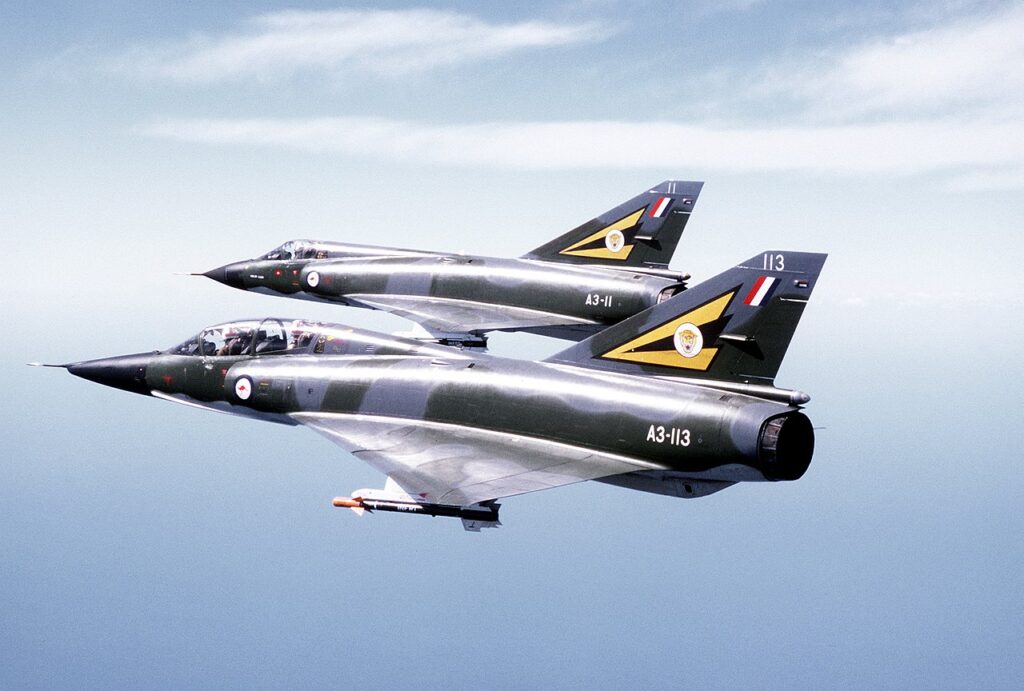 A Mirage III D (foreground) and Mirage III O aircraft of No. 2 Operational Conversion Unit RAAF in flight during a combined US-Australian Air Force exercise, Pacific Consort. (Image: Wikimedia Commons)
- Year Introduced: 1961
- Number Built: ~1,400
- Length: 49 ft 8 in (15.1 m)
- Wingspan: 27 ft (8.2 m)
- Weight (MTOW): ~30,900 lb (14,000 kg)
- Engines: One SNECMA Atar 9C turbojet
- Top Speed: 1,460 mph (2,350 km/h) / Mach 2.2
- Range: ~1,500 mi (2,400 km) ferry
- Service Ceiling: ~55,000 ft (16,800 m)
- Loadout: Cannon; air-to-air and strike ordnance
- Aircrew: 1
The Mirage III was France’s breakout fighter export, proving that a mid-sized power could compete with US and Soviet industry leaders. The aircraft’s delta-wing design offered impressive high-speed performance and simplicity, making the Mirage III attractive to countries hoping to avoid superpower supply chains. The Mirage III was used extensively in combat, particularly in the Middle East and South Asia, where it earned a reputation for versatility and effectiveness in air-to-air combat.
7. F-5 Freedom Tiger/Tiger II (United States)
Exports: 1,400+
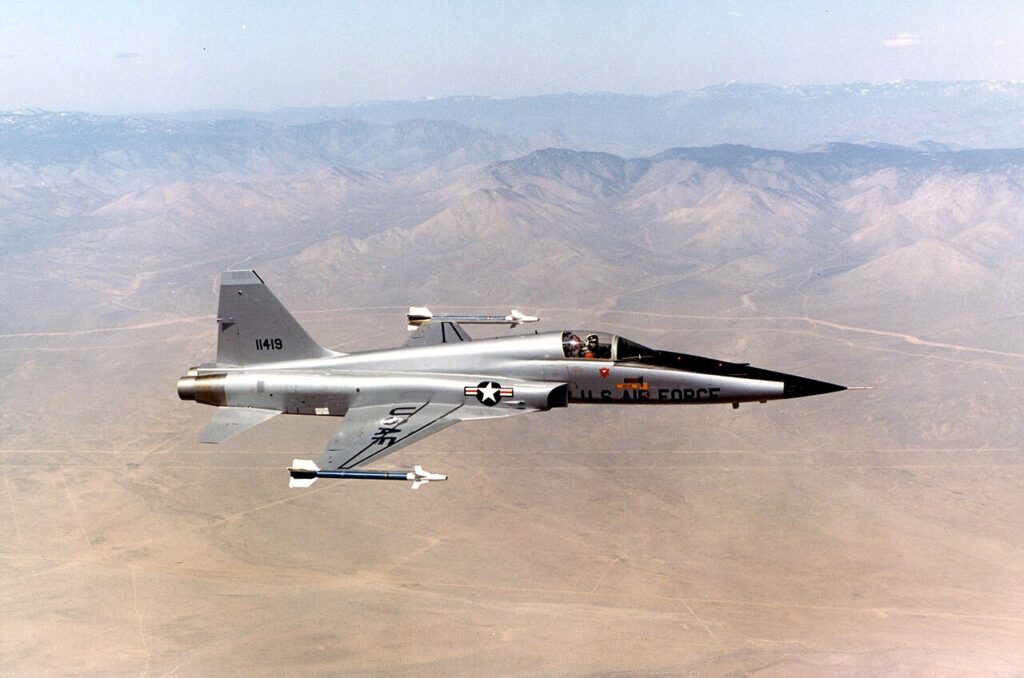 A Northrop F-5E (Tail No. 11419) in flight. (Image: Wikimedia Commons)
- Year Introduced: 1972
- Number Built: ~1,400 (F-5E/F variants)
- Length: 47 ft 2 in (14.4 m)
- Wingspan: 26 ft 8 in (8.1 m)
- Weight (MTOW): ~24,700 lb (11,200 kg)
- Engines: Two GE J85-GE-21 turbojets
- Top Speed: 1,080 mph (1,739 km/h) / Mach 1.63
- Range: ~1,400 mi (2,250 km) ferry
- Service Ceiling: ~51,800 ft (15,800 m)
- Loadout: Two 20mm cannons; weapons on 7 hardpoints
- Aircrew: 1
The F-5 was designed explicitly for export—and it was a brilliant success. Cheap and reliable and easy to maintain, the F-5 gave developing air forces access to supersonic combat aviation without overwhelming logistics demands.
The F-5E Tiger II improved the original F-5’s radar, engines, and weapons, extending the type’s relevance. At its peak, dozens of countries operated the F-5, and many still do today—a tribute to an affordable and simple aircraft that punched well above its weight.
6. MiG-15 (Soviet Union)
Exports 1,500-2,000
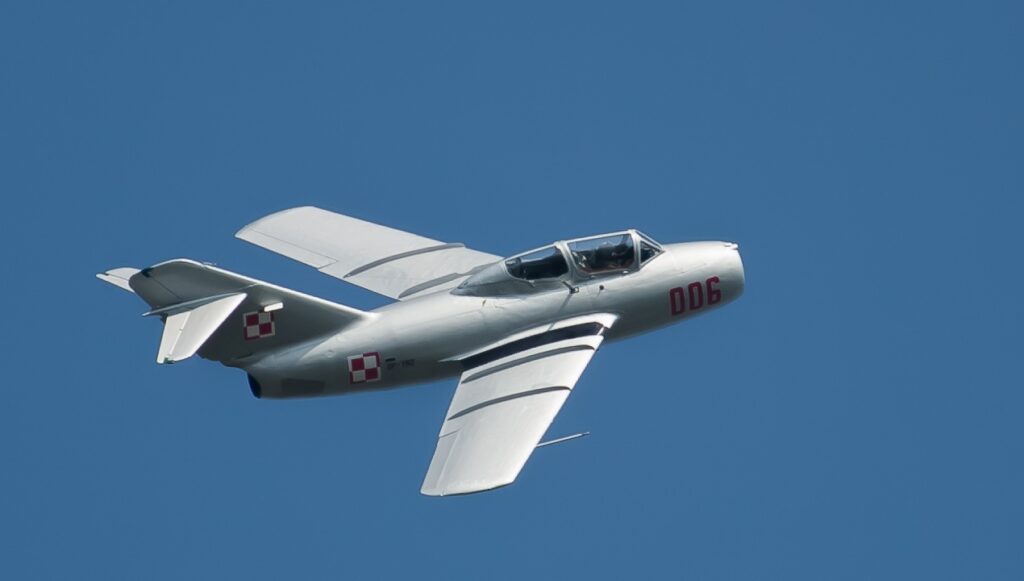 A Polish MiG-15 in flight in 2011. (Image: Wikimedia Commons / Jim van de Burgt)
- Year Introduced: 1949
- Number Built: ~18,000 (all variants)
- Length: 33 ft 2 in (10.1 m)
- Wingspan: 33 ft 1 in (10.1 m)
- Weight (MTOW): ~13,700 lb (6,200 kg)
- Engines: One Klimov VK-1 turbojet
- Top Speed: ~670 mph (1,080 km/h) / Mach 0.92
- Range: ~745 mi (1,200 km)
- Service Ceiling: ~51,000 ft (15,500 m)
- Loadout: 23mm and 37mm cannons
- Aircrew: 1
The MiG-15 singlehandedly launched the jet age for a large portion of the world. After proving itself on the Chinese and North Korean side in the Korean War, it became the standard jet fighter across the Eastern Bloc and beyond for much of the 1950s and 1960s. Simple, rugged, and easy to produce, the MiG-15 spread rapidly through allied and non-aligned nations. While somewhat rudimentary in construction—and notably unable to break the sound barrier, a standard feature of later fighter jets in both the East and the West—the MiG-15’s swept wing design saw abundant combat experience, giving it an outsized impact on early Cold War air power.
5. F-4 Phantom II (United States)
Exports: 2,000
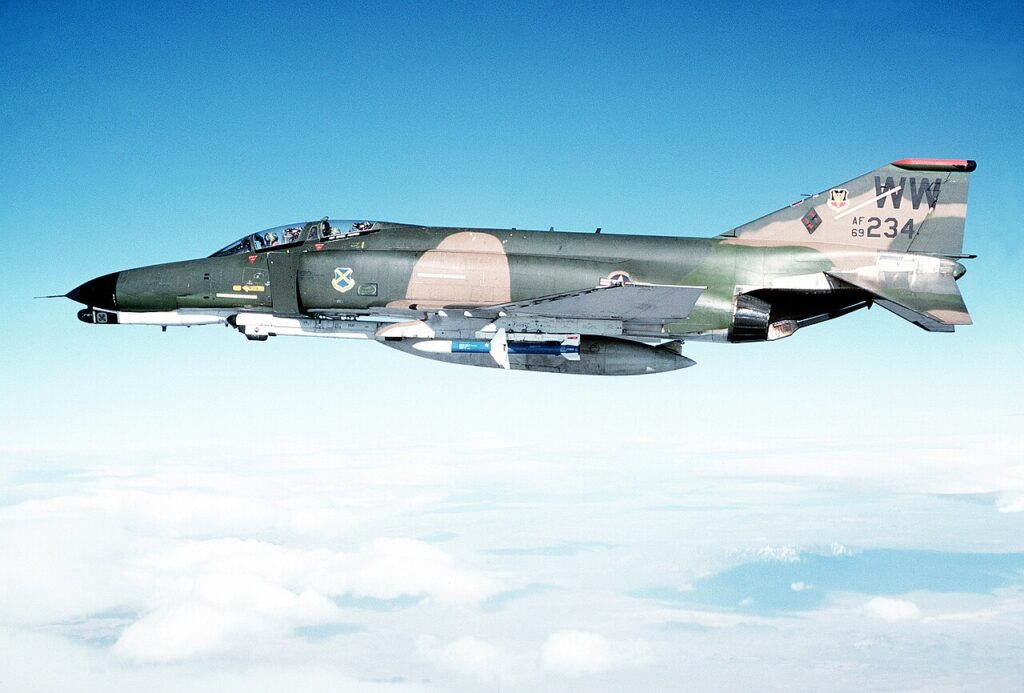 A US Air Force F-4G Phantom II (s/n 69-7234) in flight during Exercise Gallant Eagle ’82 near George Air Force Base, California (USA), 1 April 1982. The F-4E-43-MC 69-7234 (c/n 3902) was loaned to the RAAF from 1970 to 1973. Subsequently modified to F-4G in 1972, to AMARC in 1991, to QF-4G in 1999. (Air Force photo by Garfield F. Jones)
- Year Introduced: 1961
- Number Built: ~5,200
- Length: 63 ft (19.2 m)
- Wingspan: 38 ft 5 in (11.7 m)
- Weight (MTOW): ~61,800 lb (28,000 kg)
- Engines: Two GE J79 turbojets
- Top Speed: 1,470 mph (2,370 km/h) / Mach 2.23
- Range: ~1,600 mi (2,600 km) ferry
- Service Ceiling: ~60,000 ft (18,300 m)
- Loadout: Missiles and bombs up to ~18,000 lb
- Aircrew: 2
The F-4 Phantom II was a monster. Fast, powerful, and versatile, it was widely exported amongst NATO allies and partners, serving as an interceptor, fighter-bomber, and reconnaissance platform. Countries like Israel, Germany, Japan, and Turkey relied on the F-4 for decades. The jet was expensive and complex, but the hassle was worthwhile: the F-4 offered unmatched performance for its era. Today, the only nations that continue to operate the F-4 are Greece, Turkey, and Iran.
4. MiG-19 (USSR)
Exports: 2,000+
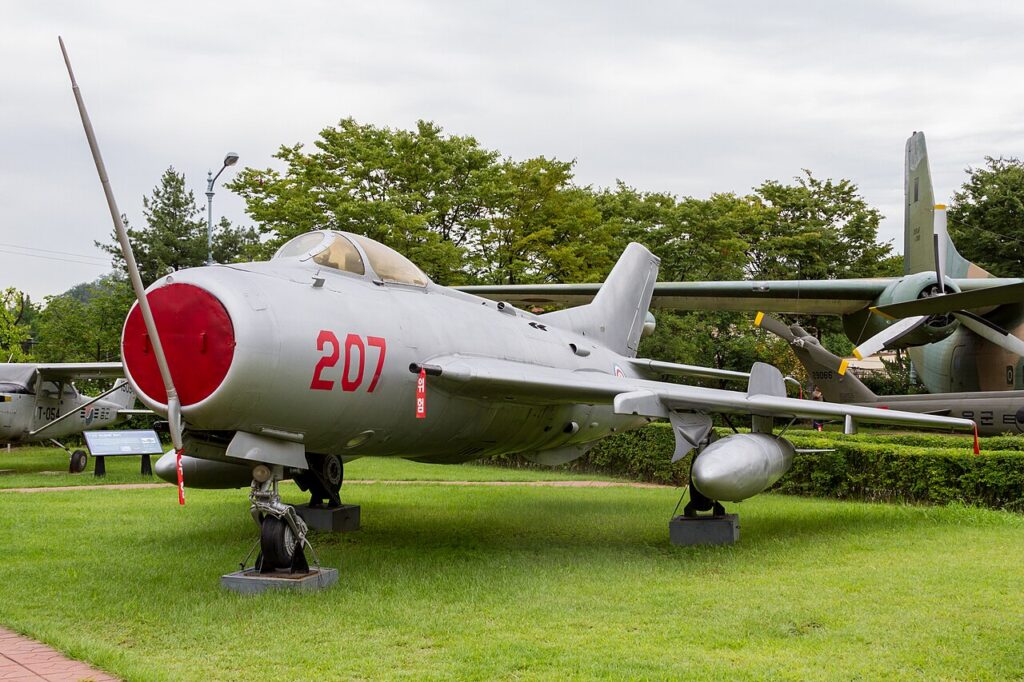 A MiG-19 Farmer on display at the War Memorial of Korea. (Image: Wikimedia Commons / Balon Greyjoy)
- Year Introduced: 1955
- Number Built: ~2,200
- Length: 39 ft 8 in (12.1 m)
- Wingspan: 29 ft 6 in (9.0 m)
- Weight (MTOW): ~19,600 lb (8,900 kg)
- Engines: Two Tumansky RD-9 turbojets
- Top Speed: 902 mph (1,452 km/h) Mach 1.3
- Range: ~1,000 mi (1,600 km) ferry
- Service Ceiling: ~59,000 ft (18,000 m)
- Loadout: Cannon; limited bombs/rockets
- Aircrew: 1
The MiG-19 was the first Soviet supersonic fighter, which in turn became the first supersonic fighter for much of the developing world. Though finicky and requiring heavy maintenance routines, the MiG-19 was widely exported and license-built—especially in China, filling a critical transitional role between early jets and more refined designs. While the MiG-19’s service record is mixed, the sheer number of exports gave it a meaningful impact across much of the developing world during the Cold War.
3. MiG-17 (USSR)
Exports: 3,000+
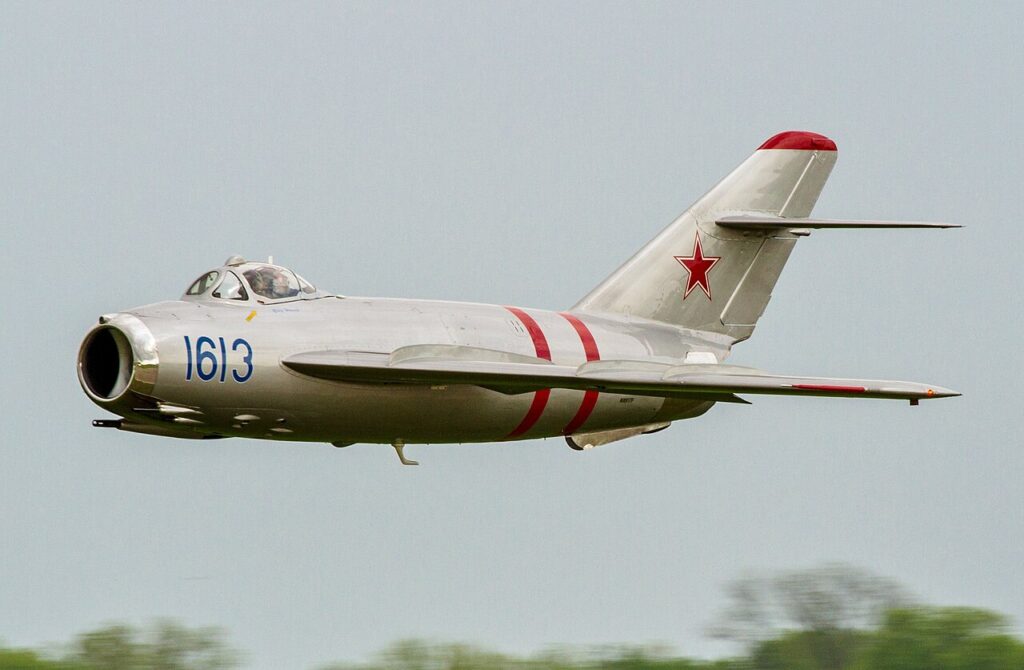 A MiG-17 performing a low pass at Take to the Skies Airfest 2016 in Durant, Oklahoma. (Image: Wikimedia Commons / Balon Greyjoy)
- Year Introduced: 1952
- Number Built: ~10,000
- Length: 37 ft 3 in (11.4 m)
- Wingspan: 31 ft 7 in (9.6 m)
- Weight (MTOW): ~13,900 lb (6,300 kg)
- Engines: One Klimov VK-1F turbojet
- Top Speed: ~715 mph (1,150 km/h) / Mach 0.93
- Range: ~760 mi (1,225 km)
- Service Ceiling: ~54,500 ft (16,600 m)
- Loadout: 23mm and 37mm cannons
- Aircrew: 1
The MiG-17 was arguably the most combat-proven export fighter of the Cold War. Though subsonic like its MiG-15 predecessor, the MiG-17 was highly agile, capable of embarrassing more advanced contemporaries in the skies over Vietnam and the Middle East. Rugged and cheap, the MiG-17 was lethal in the hands of the right pilot. The aircraft’s longevity reinforced the Soviet model emphasizing mass and simplicity and pilot skill over complexity—and proving that a simple, limited aircraft could have outsized strategic impact.
2. F-16 Fighting Falcon (United States)
Exports: 4,500+ (and growing)
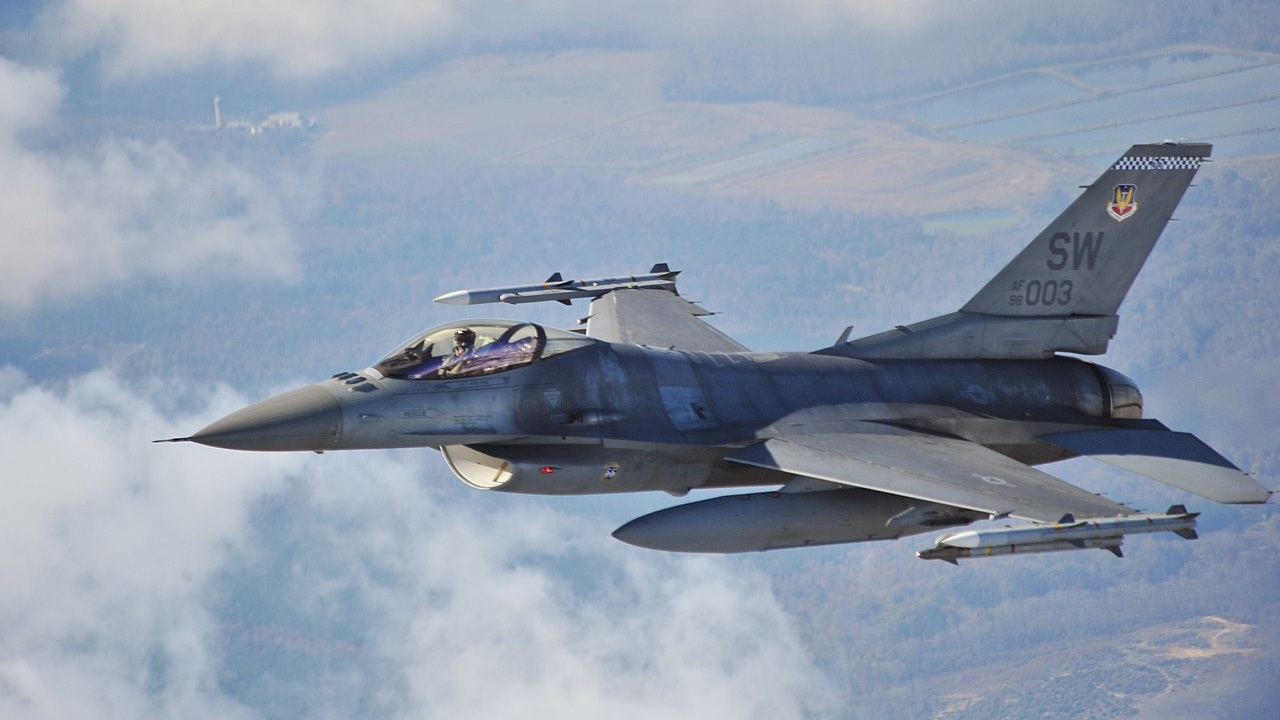
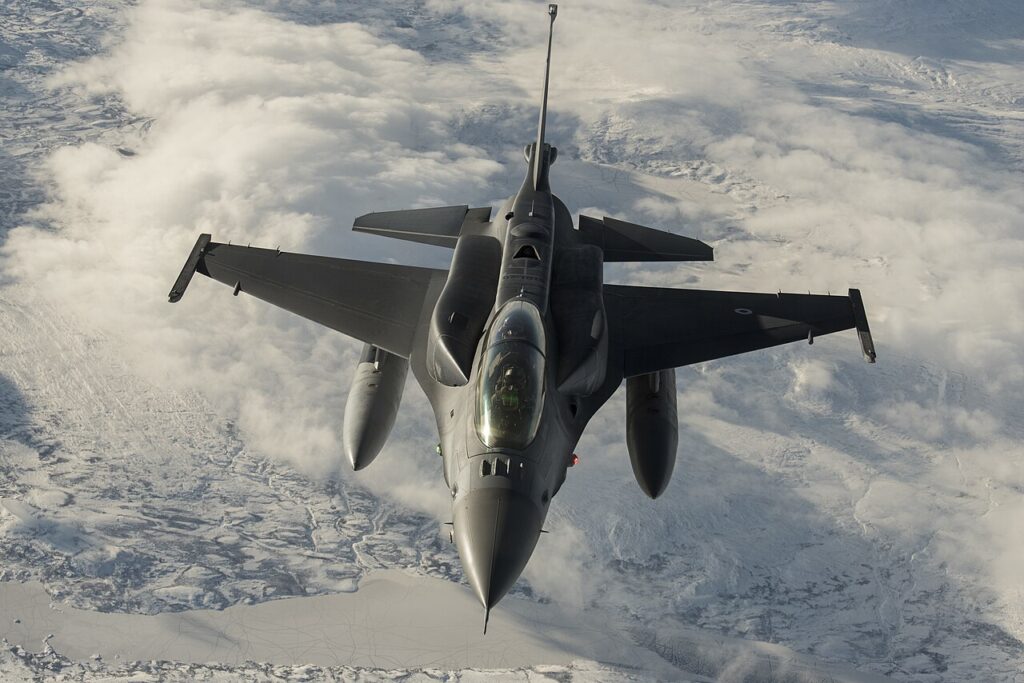 A Turkish F-16 Fighting Falcon disconnects from a US Air Force KC-135 Stratotanker during Exercise Trident Juncture 18 near Kallax Air Base, Sweden, Oct. 29, 2018. With more than 50,000 participants from 31 nations, this is NATO’s largest exercise since 2002. (US Air Force photo by Staff Sgt. Jonathan Snyder)
- Year Introduced: 1978
- Number Built: ~4,600+
- Length: 49 ft 5 in (15.1 m)
- Wingspan: 32 ft 8 in (10.0 m)
- Weight (MTOW): ~42,300 lb (19,200 kg)
- Engines: One Pratt & Whitney F100 or GE F110 turbofan
- Top Speed: ~1,353 mph (2,178 km/h) / Mach 2.0
- Range: ~2,600 mi (4,200 km) ferry
- Service Ceiling: ~50,000+ ft (15,240 m)
- Loadout: Cannon; up to ~17,000 lb of weapons
- Aircrew: 1
The F-16 is the most successful Western fighter export in history, and the standard-bearer for mid-tier exports today. The F-16’s appeal lies in its great versatility, the ability to complete a wide variety of different missions. Through upgrades, the F-16 has retained relevance, despite being 50 years old.
Even today, newly built F-16s are sold worldwide, meaning the platform’s export number is still growing; the F-16 will be flying worldwide for decades to come, demonstrating how attractive a well-balanced, upgradeable design can be on the international market.
1. MiG-21 (USSR)
Exports: 10,000+
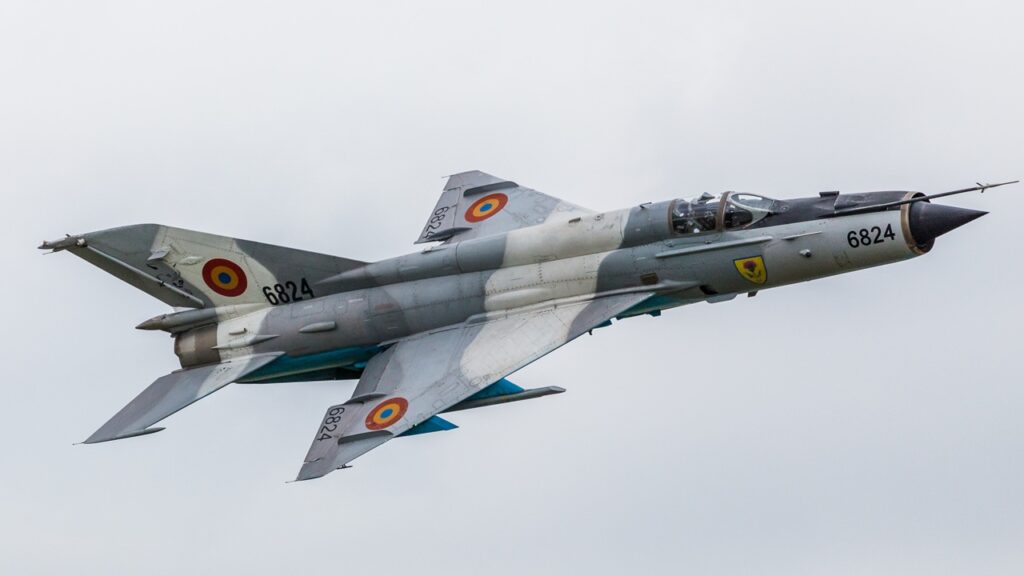 Romanian Air Force MiG-21 Lancer C captured at the 2019 Royal International Air Tattoo at RAF Fairford. (Image: Shutterstock / Jason Wells)
- Year Introduced: 1978
- Number Built: ~4,600+
- Length: 49 ft 5 in (15.1 m)
- Wingspan: 32 ft 8 in (10.0 m)
- Weight (MTOW): ~42,300 lb (19,200 kg)
- Engines: One Pratt & Whitney F100 or GE F110 turbofan
- Top Speed: ~1,351 mph (2,175 km/h) / Mach 2.0
- Range: ~2,600 mi (4,200 km) ferry
- Service Ceiling: ~50,000+ ft
- Loadout: Cannon; up to ~17,000 lb of weapons
- Aircrew: 1
In terms of pure export volume, the MiG-21 stands in a class of its own, with twice the exports of the next closest competitor. Cheap, simple, and rugged, the MiG-21 became the default supersonic fighter for the developing world for nearly all of the Cold War. Operated by more than 60 countries, the MiG-21 has fought in nearly every major Cold War conflict. The aircraft suffered from its share of limitations—short range, poor fuel capacity, poor low-speed handling, and limited avionics—but its availability and simplicity offset the limitations, making the aircraft highly attractive to bargain shoppers. The MiG-21 remains the most widely distributed supersonic fighter in history—a title that, in the era of ultra-high performance, custom-made aircraft, it will probably never lose.
About the Author: Harrison Kass
Harrison Kass is a senior defense and national security writer at The National Interest. Kass is an attorney and former political candidate who joined the US Air Force as a pilot trainee before being medically discharged. He focuses on military strategy, aerospace, and global security affairs. He holds a JD from the University of Oregon and a master’s in Global Journalism and International Relations from NYU.
Image: Wikimedia Commons.
The post The 10 Most Commonly Exported Fighter Jets appeared first on The National Interest.
Источник: nationalinterest.org