

«Данное сообщение (материал) создано и (или) распространено иностранным средством массовой информации, выполняющим функции иностранного агента, и (или) российским юридическим лицом, выполняющим функции иностранного агента»
 Topic: Air Warfare Blog Brand: The Buzz Region: Americas Tags: Defense Industry, F-35 Lightning II, Fighter Jets, Lockheed Martin, North America, Northrop Grumman, and United States Northrop Grumman Just Made Its 1,500th F-35 Fuselage. You Read That Right. January 23, 2026 By: Peter Suciu
Share
Though Lockheed Martin is the primary contractor for the F-35 Lightning II fighter jet, nearly every major US defense firm has a hand in its production.
It isn’t exactly a trick question to ask, “What company makes the F-35 Lightning II?” The simple answer, of course, is Lockheed Martin. But in reality, the plane’s manufacturing isn’t nearly so straightforward.
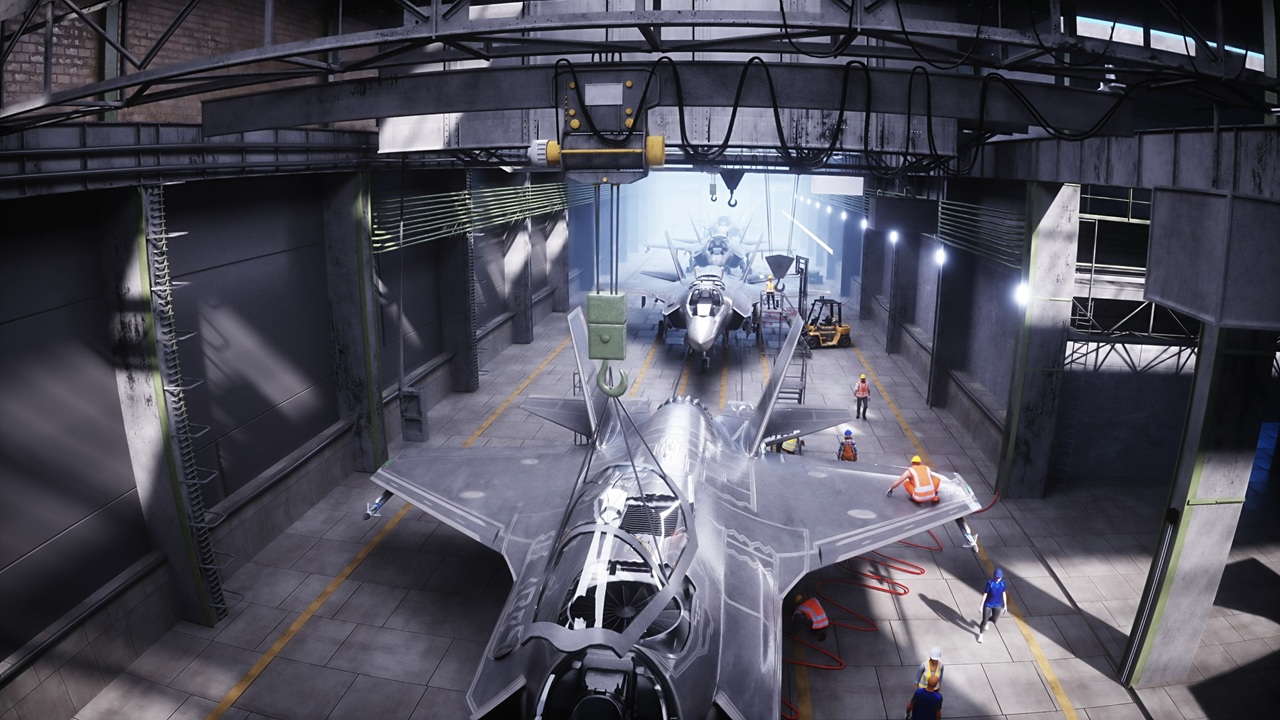
That point was clear earlier this month, after Northrop Grumman—in theory a direct competitor to Lockheed Martin—announced that its Integrated Assembly Line (IAL) in Palmdale, Calif., had delivered the 1,500th center fuselage for the fifth-generation stealth fighter.
“Using advanced manufacturing technologies, the IAL delivers one center fuselage every 30 hours and seamlessly produces center fuselages for all three F-35 variants on a single production line,” Northrop Grumman said in a statement. It credited the use of augmented reality and virtual reality (AR/VR) tools, which led to a 35 percent reduction in assembly time.
So why is Northrop Grumman building the fuselage of a Lockheed Martin aircraft?
“Northrop Grumman is a principal partner and teammate on the F-35 Lightning II industry team,” the company added—noting that it “also produces the F-35’s AN/APG-81 AESA radar, along with distinct microchips needed by the sensor to support the integrated communication, navigation, identification (CNI) system and wing skins, leading the industry team in low observable technologies.”
Everyone Has a Hand in Building the F-35—for Better or Worse
The F-35 program could be described as “too big to fail” for the US government. Indeed, the program, originally known as the Joint Strike Fighter, was long a horror story for its bloat and its inability to meet deadlines and requested specifications. Today, even as many of these issues have been ironed out, the program is far too big for one defense firm—even the world’s largest aerospace and defense contractor—to handle on its own.
Lockheed Martin remains the “prime contractor” for the F-35, which is why all of the US military’s Lightning IIs continue to roll out of the firm’s Fort Worth, Texas, facility. But in addition to Northrop Grumman, other major partners include BAE Systems, which produces the rear fuselage and electronic systems, and RTX, the maker of the F-35 Gen III Helmet Mounted Display System (HMDS). RTX subsidiary Pratt & Whitney manufactures the F135 engines for the stealth fighter.
The F-35 program is also supported by a global supply chain involving more than 13,000 companies that produce the components, technology, and services for the multirole fighter. To foster innovation, Lockheed Martin Ventures’ arm now invests in more than 120 companies to develop technologies that can be adopted into aircraft.
The F-35 Is the Most-Produced Fifth-Gen Fighter in the World
With more than 1,300 aircraft produced, the F-35 has been touted as the most successful fifth-generation fighter program to date—far outpacing production of Russia’s comparable Su-57 Felon and China’s J-20 Mighty Dragon. Earlier this month, Lockheed Martin also announced that it had delivered 191 F-35 Lightning II aircraft in all variants during 2025—marking a “record-breaking year” for the fifth-generation stealth fighter program. This number surpassed the previous delivery record of 142 warplanes in 2021.
The company further stated that “annual F-35 production” was “at a pace five times” that of any other allied combat fighter program, underscoring the F-35’s “scale and maturity.”
Yet, despite the praise, there is still room for improvement.
The F-35 experienced delivery delays due to issues with its Technology Refresh-3 (TR-3) hardware/software update. More importantly, the US Department of Defense’s (DoD’s) Inspector General has expressed concerns over the F-35’s mission readiness rate, which remains far below expectations. In FY24, the F-35 averaged a 50 percent rate, meaning that half of the aircraft in the Pentagon’s fleet were unavailable for combat operations.
About the Author: Peter Suciu
Peter Suciu has contributed over 3,200 published pieces to more than four dozen magazines and websites over a 30-year career in journalism. He regularly writes about military hardware, firearms history, cybersecurity, politics, and international affairs. Peter is also a contributing writer for Forbes and Clearance Jobs. He is based in Michigan. You can follow him on Twitter: @PeterSuciu. You can email the author: Editor@nationalinterest.org.
Image: Shutterstock / Pavel Chagochkin.
The post Northrop Grumman Just Made Its 1,500th F-35 Fuselage. You Read That Right. appeared first on The National Interest.
Источник: nationalinterest.org