

«Данное сообщение (материал) создано и (или) распространено иностранным средством массовой информации, выполняющим функции иностранного агента, и (или) российским юридическим лицом, выполняющим функции иностранного агента»
 Topic: Naval Warfare Blog Brand: The Buzz Region: Americas Tags: Battleships, Donald Trump, North America, Shipbuilding, United States, and US Navy Why the Trump-Class “Battleship” Will Never Set Sail January 23, 2026 By: Brandon J. Weichert
Share
The US Navy does not need the Trump-class vessel—and is unlikely to ever get it.
“I did not expect to be told to build a battleship,” United States Navy Rear Admiral Derek Trinque, the Navy staff’s surface warfare director, told reporters after President Donald Trump’s announcement of a new class of battleship—perhaps predictably named after himself.
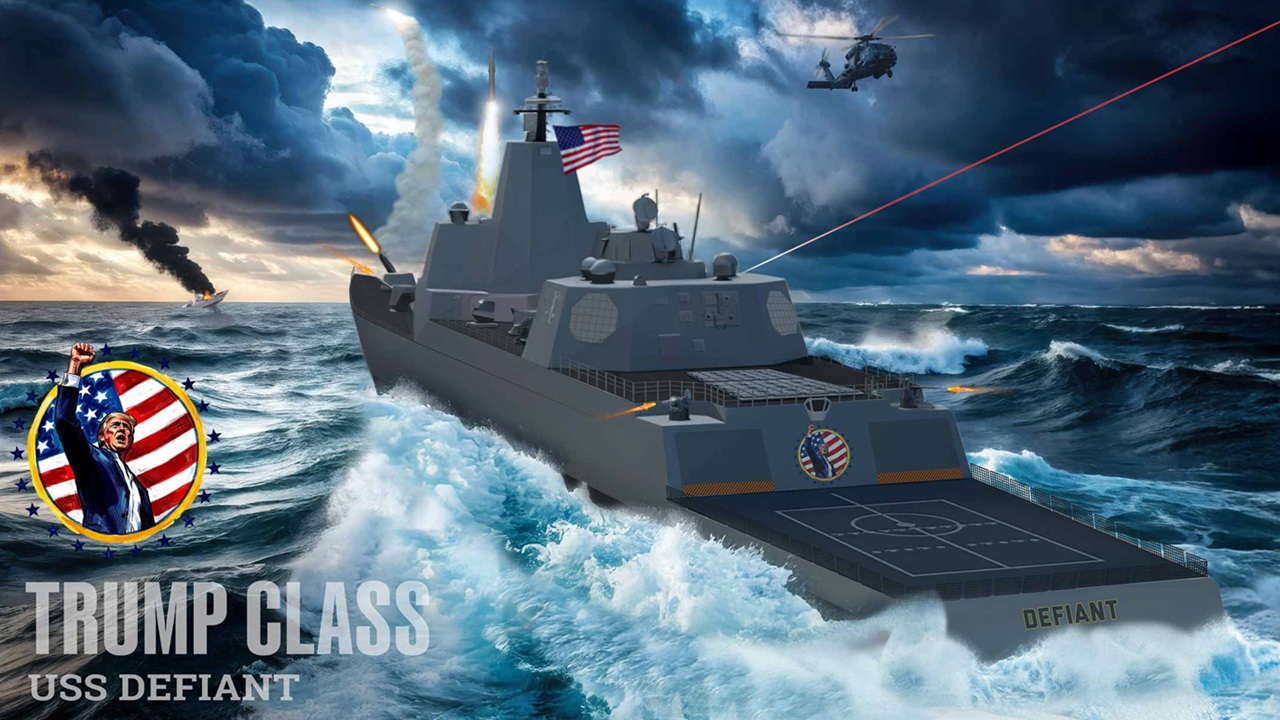
That rueful remark by one of the Navy’s top acquisitions experts was far more insightful than many realized. It indicated the way in which the US Navy leadership was blindsided by Trump’s recent—and frankly bizarre—announcement that he was ordering the creation of the USS Defiant, which would be the first of the new class.
Let’s clarify a few things first, though.
What Exactly Is the Trump Class?
Trump has repeated that the new ship is a “battleship,” akin to the famed Iowa class of the World War II era. But all the specifications about this proposed warship show that is not a battleship. It is, more technically, a battlecruiser, similar to the Russian Navy’s Project 1144 battlecruiser.
Recently, the Russians conducted sea and factory trials of their battlecruiser, the Admiral Nakhimov. This massive warship is basically a giant missile truck that will carry both the advanced Zircon hypersonic cruise missiles along with advanced S-400 air defense systems.
The Russian battlecruiser was originally built at the end of the Cold War as a Soviet Navy warship. It languished, along with its three other sister ships, languished for years. Ultimately, Admiral Nakhimov and one of her sister ships, the Pyotr Velikiy, remained.
The Russian government chose to do something with this massive warship rather than simply scuttle it. Given the demands that the Ukraine War and other hostilities with the West have placed on the Russian Armed Forces, many resources have gone into ground and air capabilities for the war.
So, the Russian Navy is augmenting what it already has. That makes sense, all things considered. What’s more, the Admiral Nakhimov actually fits well into existing Russian naval doctrine.
The primary goal of the Admiral Nakhimov has always been to serve as an aircraft carrier hunter/killer. Since the US Navy’s primary surface combatant has been the aircraft carrier since World War II, the Russians have long desired to negate this capability. Successfully damage or destroy American carriers, and you’ve successfully stunted the US Navy’s ability to threaten you.
There’s No Logical Reason for America to Buy a New Battlecruiser
But Russia lacks an aircraft carrier fleet of its own. And it is unlikely to acquire one anytime soon. The Russian Navy’s primary threat to the United States Navy is its submarine fleet. How does the Trump-class battlecruiser augment the US Navy’s offensive capabilities?
In the case of Russia’s naval threat, it does little. Admiral Nakhimov is a US carrier killer. Russia doesn’t have carriers (aside from the pitiful Admiral Kuznetsov, which has one foot in the grave already). What will the Trump-class hunt down? In fact, Russia’s entire surface fleet is relatively small.
I have long been critical of aircraft carriers in the modern era, but they make sense within US naval doctrine. They bring a host of capabilities that no battleship or battlecruiser does. The carrier’s biggest flaw is that it is vulnerable to the kind of anti-ship and anti-access/area-denial (A2/AD) attacks that China and Russia (and Iran) have developed as their main defenses against US carriers. Beyond that, though, the carrier brings a range of helpful capabilities to the table.
Nostalgia for the era of the Iowa-class aside, the debate between battleships versus aircraft carriers has long ago been decided. Carriers won, and battleships lost. Even during World War II, battleships were relegated to a support role. And though the Iowa-class battleships served for many years afterwards with distinction—up to and through the Gulf War of 1991—they were ultimately decommissioned because their era had passed.
DDG(X) on Steroids—or a Giant, Floating Target?
Defense One, an online industry publication, describes the proposed Trump-class as the “DDG(X) concept and put that on steroids, under the assumption that the counter-targeting efforts of the Navy will protect it and make it survivable.”
No naval expert ought to believe this. First of all, the Navy cannot make any of their surface warships “survivable” in the face of the comprehensive anti-ship and A2/AD threats they face on the modern battlefield.
Second, the Navy has indicated that they want to place its hypersonic “Conventional Prompt Strike” (CPS) “but on steroids” on the Trump-class battlecruiser. The CPS is a system the military is developing that can deliver a precision-guided weapon—hypersonic weapon—strike anywhere in the world in under one hour.
The Navy has been struggling to place such a system on its disastrous Zumwalt-class destroyers. One of the main problems facing the hypersonic CPS is that the Navy, like the rest of the United States military, has no standoff hypersonic weapon. In fact, the entire arsenal of the proposed Trump class is more fiction than science.
Not only does the Navy intend to have hypersonic weapons in abundance onboard the battlecruisers that do not yet exist, but they also intend to have directed-energy weapons (DEWs), and even railguns. In the case of both DEWs and railguns, the Navy had such a terrible time developing these systems after, in some cases, 20 years of research that they just abandoned them.
Every Part of the Trump Class Proposal Costs Too Much
Another weapon system that’s been floated around by newfound battleship devotees in DC is the use of the Advanced Gun System (AGS). Mind you, the AGS is not new. It’s a 155mm naval artillery system developed by BAE Systems for the US Navy’s Zumwalt-class destroyer that is designed for long-range shore bombardment with automated handling, but employing a specialized, Long Range Attack Projectile (LRLAP). But, like the Zumwalt, the AGS was a failure—costing up to $1 million per round.
Thus, the Navy canceled the LRLAP in 2016, leaving the AGS without anything to fire. Now the Trump administration is rumored to want to create even larger variants of the AGS for their battlecruiser boondoggle.
Oh, and speaking of costs, it is projected that each ship would cost a minimum of $22 billion and take more than a decade to build.
Given how shabby America’s naval shipyards are, how much do you want to bet that these warships will go over budget and way over time? Let us remember, too, that the Navy has had a string of epic embarrassments when it comes to their shipyards. The aforementioned Zumwalt-class destroyer is a major letdown, while the Littoral Combat Ship (LCS) has long held the moniker of “Little Crappy Ship” among sailors. Meanwhile, the Navy completely botched the now-canceled Constellation-class frigate—the ship that was ironically raised as the efficient, low-cost solution to the LCS and Zumwalt fiascoes.
Clearly, the Navy has forgotten how to build warships. And Trump wants to use these same folks to build something named for himself?
Here’s What the Navy Should Be Building Instead
This entire ordeal is excessive (even for Trump). In the age of anti-ship missiles, anti-ship drone swarms, advanced submarines and unmanned underwater vehicles (UUVs), and A2/AD systems, having a massive battlecruiser is little more than an easy target for America’s enemies.
Rather than building the American version of the Bismarck or the HMS Hood, the Americans should be breaking down their capabilities into small drone swarms at sea and fundamentally prioritizing the submarine.
If these battlecruisers ever make it to production, if they even make it to sea, they will be little more than easy targets for America’s innovative, ravenous enemies. All the resources poured into a single one of these ridiculous warships could have gone to drones, hypersonic weapons research and development, DEW development, and submarines.
Trump is setting the United States up for a humiliating defeat with these ships—if they ever make it off the drawing board. That, of course, is particularly dubious, given that Congress controls the purse strings for the military. The battleship will take many years to build, and before it is complete, Democrats are likely to retake one or both houses of Congress. When they do, it is almost certain their first target will be the project that Trump has tied to his legacy.
But perhaps this is a mercy, as these ships are going to be sunk early in any major war. Bigger isn’t always better.
About the Author: Brandon J. Weichert
Brandon J. Weichert is a senior national security editor at The National Interest. Recently, Weichert became the host of The National Security Hour on America Outloud News and iHeartRadio, where he discusses national security policy every Wednesday at 8pm Eastern. Weichert hosts a companion book talk series on Rumble entitled “National Security Talk.” He is also a contributor at Popular Mechanics and has consulted regularly with various government institutions and private organizations on geopolitical issues. Weichert’s writings have appeared in multiple publications, including The Washington Times, National Review, The American Spectator, MSN, and the Asia Times. His books include Winning Space: How America Remains a Superpower, Biohacked: China’s Race to Control Life, and The Shadow War: Iran’s Quest for Supremacy. His newest book, A Disaster of Our Own Making: How the West Lost Ukraine is available for purchase wherever books are sold. He can be followed via Twitter @WeTheBrandon.
Image: Wikimedia Commons.
The post Why the Trump-Class “Battleship” Will Never Set Sail appeared first on The National Interest.
Источник: nationalinterest.org