

«Данное сообщение (материал) создано и (или) распространено иностранным средством массовой информации, выполняющим функции иностранного агента, и (или) российским юридическим лицом, выполняющим функции иностранного агента»
 Topic: Air Warfare Blog Brand: The Buzz Region: Americas, and Middle East Tags: F-15 Eagle, F-35 Lightning II, Fighter Jets, Jordan, United Kingdom, and United States Why Is the US Air Force Moving F-15E Strike Eagles into the Middle East? January 22, 2026 By: Peter Suciu
Share
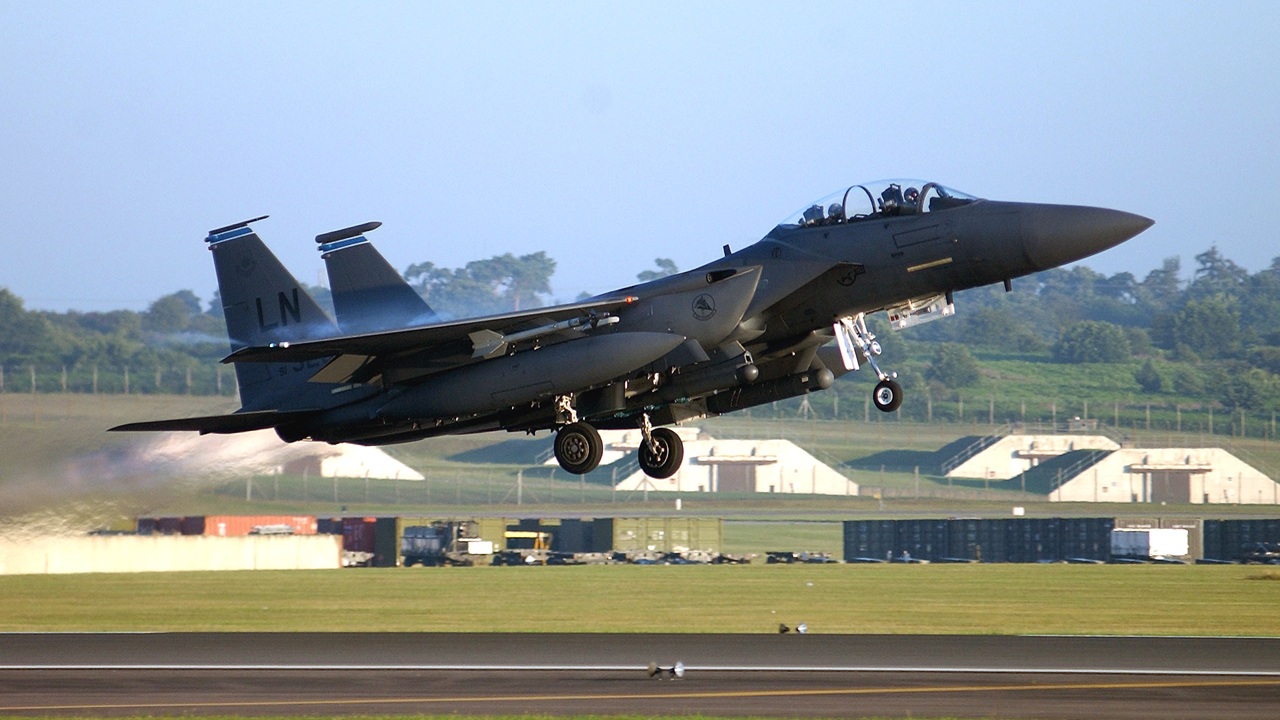
The F-15E Strike Eagles were originally intended to return to bases in the United States, replaced in their British posting by F-35 Lightning II fighter jets.
Last spring, the United States Air Force confirmed it would proceed with plans to withdraw two F-15E Strike Eagle fighter squadrons from Royal Air Force (RAF) Lakenheath. This week, the aircraft began to depart from the base in Suffolk, England—but the warbirds aren’t flying home to the United States.
According to multiple open-source intelligence reports, the F-15Es from the 492nd and 494th Fighter Squadrons, which have been permanently forward-deployed to the UK since the early 1990s, could be headed instead to the Middle East. As many as 35 F-15Es had arrived in Jordan as of Monday, with 24 of the aircraft coming from RAF Lakenheath.
The F-15Es Were Set to Fly Home—but Something Changed
The United States Air Force isn’t actually scaling back its presence at RAF Lakenheath. Instead, the aging F-15Es will be replaced by the Lockheed Martin F-35 Lightning II. The plan was presented to US lawmakers on the Senate Armed Services Committee during a recent hearing on the Posture of the Department of the Air Force in Review of the Defense Authorization Request for Fiscal Year 2026.
It wasn’t clear whether the plan called for the Strike Eagles to be based in the United States, possibly with an Air National Guard unit, or to be retired. However, there was speculation that several swaps could be made.
The F-15E Strike Eagles deployed to RAF Lakenheath were noted for being equipped with the more powerful F100-PW-229 turbofans. At the same time, the F-15Es based at Seymour Johnson Air Force Base (AFB), North Carolina, are outfitted with somewhat older Pratt and Whitney F100-PW-220 engines. The latter base is home to the 4th Fighter Wing, a frontline and training squadron that operates the Strike Eagle.
What to Know About the F-15E Strike Eagle
- Year Introduced: 1989
- Number Built: Approx. 513
- Length: 63 ft 9 in (19.43 m)
- Wingspan: 42 ft 10 in (13.05 m)
- Weight: ~44,500–50,000 lb (20,185–22,680 kg) under standard conditions
- Engines: Two Pratt & Whitney F100-PW-229 afterburning turbofans; 29,000 lbf thrust each with afterburner
- Top Speed: 1,875+ mph (3,017 km/h) / Mach 2.5+ at altitude
- Combat Radius: ~790 mi (1,270 km) with typical load
- Service Ceiling: 60,000 ft (18,300 m)
- Loadout: One M61A1 Vulcan 20mm rotary cannon; ~23,000 lb (10,400 kg) payload capacity; can carry variety of air-to-air and air-to-ground missiles
- Aircrew: 2 (Pilot and Weapon Systems Officer)
The F-15E Strike Eagle was derived from the all-weather McDonnell Douglas F-15 Eagle air superiority fighter. The design included a secondary ground-attack capability, which, with the Strike Eagle, was expanded into a ground-attack aircraft that retained air combat capabilities.
The Strike Eagle was designed as a dual-role fighter capable of performing air-to-air and air-to-ground missions. In April 1988, the first production model of the F-15E was delivered to the 405th Tactical Training Wing, Luke AFB, Arizona.
As Harrison Kass explained for The National Interest, the dual-capable Strike Eagle could be ideally-suited for operations in the Middle East, able to serve in both an air superiority and ground-attack role.
“F-15E missions are planned extensively,” Kass wrote. “Pilots and their weapon systems officers (WSO) are briefed on operational objectives, threat assessments, weather conditions, rules of engagement, and available support assets (AWACS, tankers, electronic warfare platforms). Flight routes are carefully planned with terrain-masking, used to reduce the likelihood of detection on enemy radar.”
The US Air Force has 218 F-15Es in its fleet.
America’s Middle East Buildup Continues
The F-15Es are just part of a build-up in the Middle East. Earlier this month, the Pentagon ordered the United States Navy’s Nimitz-class nuclear-powered supercarrier USS Abraham Lincoln (CVN-72) to the region. The carrier had been operating in the South China Sea after departing San Diego with little fanfare in November 2025.
The warship and her Carrier Strike Group (CSG) are expected to arrive in the region by early next week.
There has also been speculation that the USS George H.W. Bush (CVN-77), the final Nimitz-class carrier to enter service, could also be dispatched to the region. The flattop has departed Naval Station Norfolk, Virginia, and may be headed to the Mediterranean.
USS Dwight D. Eisenhower (CVN-69), which also departed from Norfolk, will likely take over duties in the Caribbean from USS Gerald R. Ford (CVN-78), the service’s newest supercarrier. CVN-78’s deployment began in May, and the carrier has been supporting US Southern Command operations as part of the US military buildup to counter the regime of Nicolas Maduro in Venezuela.
It is unclear how long the US forces will remain in the Caribbean, even as it masses its forces in the Middle East.
About the Author: Peter Suciu
Peter Suciu has contributed over 3,200 published pieces to more than four dozen magazines and websites over a 30-year career in journalism. He regularly writes about military hardware, firearms history, cybersecurity, politics, and international affairs. Peter is also a contributing writer for Forbes and Clearance Jobs. He is based in Michigan. You can follow him on Twitter: @PeterSuciu. You can email the author: Editor@nationalinterest.org.
Image: Wikimedia Commons.
The post Why Is the US Air Force Moving F-15E Strike Eagles into the Middle East? appeared first on The National Interest.
Источник: nationalinterest.org