

«Данное сообщение (материал) создано и (или) распространено иностранным средством массовой информации, выполняющим функции иностранного агента, и (или) российским юридическим лицом, выполняющим функции иностранного агента»
 Topic: Naval Warfare Blog Brand: The Buzz Region: Europe, and Oceania Tags: Astute-Class Submarine, Australia, Royal Navy, Submarines, and United Kingdom This Royal Navy Submarine Is Traveling to the Land Down Under January 21, 2026 By: Peter Suciu
Share
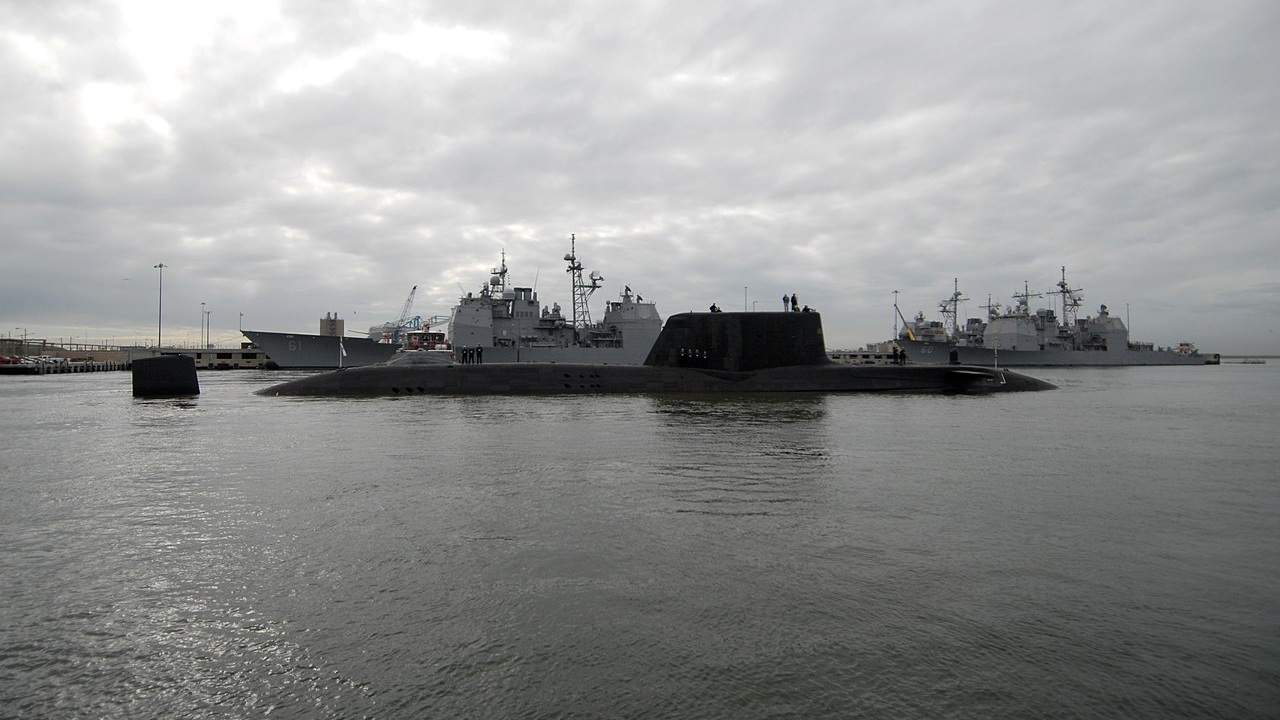
The HMS Anson is the fifth Astute-class fast attack submarine in Royal Navy service—and the eighth vessel to bear the name of George Anson, an 18th-century British admiral.
Travel from the UK to Australia is a long journey by air, but some sailors in the UK’s Royal Navy are preparing to travel to the Land Down Under underwater instead.
The Royal Navy announced that HMS Anson (S124), the senior service’s fifth Astute-class nuclear-powered fast attack submarine (SSN), departed from her home port of Faslane on January 10 and made a brief port-of-call visit to Gibraltar. The boat is now heading to join the Submarine Rotational Force-West at HMAS Stirling in Western Australia.
The deployment comes as the Royal Navy is stretched thin with SSNs tasked with protecting the waters around the British Isles, and Russia continues to test the UK’s resolve by regularly transiting its warships and submarines through the North Sea and English Channel.
However, last month, UK Defence Minister Luke Pollard defended the deployment as part of the UK’s commitment to Australia and the AUKUS program, the trilateral alliance that is developing a next-generation nuclear submarine for Australia in support of a free and open Indo-Pacific.
“First, it is one year away because it is a 2026 rotation that we are aiming for,” explained Pollard. “Secondly, why contribute to the rotational forces in Australia? It is directly because the optimal path for delivery of AUKUS sees the Australians gaining benefits from having the ability to understand how they dock, service, maintain and operate a nuclear submarine.”
Pollard further stressed that the agreement between Australia and the United States has called for rotations between a Royal Navy Astute-class submarine and a United States Navy Virginia-class SSN, with each operating out of Western Australia.
“That will build the knowledge that the Australians will need to be able to operate those boats,” Pollard added. “In particular for the UK context, this is about understanding how they would operate a UK-designed and operated boat. Effectively, the SSN‑AUKUS will be a similar boat in terms of some of the design principles and operating style that you would see with an Astute-class submarine.”
The UK defense chief added that it will create “training opportunities” that the UK’s Royal Navy could employ in the Euro-Atlantic. He further stated that it fits within the 2025 Strategic Defence Review, which calls for 12 SSN-AUKUS submarines that will primarily serve in a hunter-killer role, likely to counter the growing submarine force of China’s People’s Liberation Army Navy (PLAN).
“That is why we have set out the importance of procuring more of them,” Pollard explained.
It is not clear how long HMS Anson could be deployed to the Indo-Pacific, but speculation is that it could operate from Australia for at least six months.
About the Astute-Class Submarine (SSN)
- Year Introduced: 2010
- Number Built: 6 (7 planned, 1 still under construction)
- Length: 97 m (318 ft)
- Beam (Width): 11.3 m (37 ft)
- Displacement: ~7,400 tonnes surfaced, ~7,800 tonnes submerged
- Propulsion: Rolls-Royce PWR2 nuclear reactor (Core H)
- Speed: 30+ knots (34.5 mph, 61 km/h)
- Range: Unlimited—up to 90 days’ endurance submerged
- Armament: Astute Combat Management System (ACMS); six 21-inch torpedo tubes; can carry up to 38 Spearfish torpedoes or Tomahawk Land Attack Cruise Missiles (TLAM Block IV/V)
- Crew: ~98 (reduced by automation)
The Royal Navy’s Astute-class boats are the largest submarines to be operated by the UK’s senior service. Each carries long-range Tomahawk Block IV cruise missiles, which are capable of hitting a target to within a few meters at a range of 1,000 miles (1,600 km), and Spearfish torpedoes, for use against enemy submarines.
BAE Systems designed the fast attack subs to replace the aging Trafalgar-class submarine, which first entered service in the mid-1980s. The final Trafalgar-class sub, HMS Triumph, was decommissioned in 2025.
Along with her operational sister subs—HMS Astute, HMS Ambush, HMS Artful, and HMS Audacious—HMS Anson is powered by a Rolls-Royce PWR2 (Core H) reactor and fitted with a pump-jet propulsor. The same reactor was developed for the Royal Navy’s Vanguard-class ballistic missile submarines. The reactor provides theoretically unlimited endurance, while it has a 25-year lifespan. It is also used to recycle air and water.
The Astute-class subs were the first nuclear-powered submarines in the world to be designed in a 3D computer-aided environment. In addition, the hunter-killer subs have been outfitted with many technological firsts, including the absence of an optical periscope. Instead, each employs high-specification video technology that enables the crew to scan the horizon and obtain a 360-degree view to address potential threats.
The Astute-class truly lives up to the concept of “silent service,” as the nuclear-powered submarines were developed to utilize state-of-the-art anti-acoustic tiles. Each boat’s hull is fitted with more than 39,000 acoustic tiles, which reduce the sonar signature while allowing the boats to glide through the water almost silently.
The hunter-killer submarine is also equipped with a dry-deck shelter to allow Special Forces, such as the Royal Marine Commandos or the Royal Navy Special Boat Service (SBS), to deploy whilst the submarine is submerged.
The Submarine Honors Admiral George Anson
S124 is the eighth Royal Navy vessel to be named in honor of Admiral George Anson, beginning with a 60-gun fourth-rate ship-of-the-line built in the 18th century, and including the Admiral-class ironclad that was in service at the end of the 19th century—as well as a King George V-class battleship that was launched in 1940 and saw service in World War II.
Though the latter never once fired her main armament in anger, she was among the Allied warships present at Tokyo Bay during the official Japanese surrender that ended the Second World War.
The newest HMS Anson will now be charged with maintaining the peace in the Indo-Pacific.
About the Author: Peter Suciu
Peter Suciu has contributed over 3,200 published pieces to more than four dozen magazines and websites over a 30-year career in journalism. He regularly writes about military hardware, firearms history, cybersecurity, politics, and international affairs. Peter is also a contributing writer for Forbes and Clearance Jobs. He is based in Michigan. You can follow him on Twitter: @PeterSuciu. You can email the author: Editor@nationalinterest.org.
Image: Wikimedia Commons.
The post This Royal Navy Submarine Is Traveling to the Land Down Under appeared first on The National Interest.
Источник: nationalinterest.org