

«Данное сообщение (материал) создано и (или) распространено иностранным средством массовой информации, выполняющим функции иностранного агента, и (или) российским юридическим лицом, выполняющим функции иностранного агента»
 Topic: Naval Warfare Blog Brand: The Buzz Region: Americas Tags: Aircraft Carriers, Airstrikes, Donald Trump, Iran, Iran Protests, and US Navy An American Aircraft Carrier Is Still on the Way to Iran January 21, 2026 By: Brandon J. Weichert
Share
Though President Trump has been widely criticized for promising a strike on Iran and failing to deliver, it may only be a matter of time.
Last week, there was a moment where it seemed as though time itself slowed down in the Middle East. With protests raging on the streets of Iran, the regime panicking and killing protesters en masse, and President Donald Trump looking to fulfill his vow of ending the Iranian regime if they harmed protesters, American military action seemed imminent. Indeed, most sources indicate that it was.
Then, in the 11th hour, President Trump appeared to back off.
Why Didn’t Trump Strike Iran Last Week?
In an earlier piece for this site, I explained why the Trump administration likely turned away from striking at the last minute. One such reason was likely due to the way that American forces were arrayed throughout the region. Far too many US military personnel were exposed to a comprehensive Iranian retaliation, involving swarms of advanced drones, long-range ballistic missiles, and hypersonic weapons.
What’s more, the airpower needed to really hit the regime in the way that Trump was clearly anticipating was not fully ready for such an attack. Yes, the United States has bombers and warplanes already in the region. But Trump wants what he believes would provide American forces decisive overmatch against the Iranian forces.
Further, Trump is uncertain of how serious the Israelis are in assisting any US military action. It sounds as though the Israelis did not support what Trump wanted to do last week, in part, because Jerusalem prefers a more sustained military operation directed against the Islamic Republic rather than another, minor, pinprick airstrike.
But the desire to strike the Iranian regime remains high among the US and Israeli leadership. It’s a matter of logistical and tactical alignment rather than discord over the mission. It seems clear that Trump is aiming for regime change. In the 12-Day War, the president was content to target only some of Iran’s suspected nuclear weapons facilities. He is now intent on targeting the Islamist regime directly.
Trump Is Calling in Reinforcements
Since the aborted strike, the US military continues moving in air assets and ammunition needed to better defend physical US interests against any possible Iranian counterattack, while Trump has been rapidly drawing down what his Pentagon assesses to be non-essential forces from key bases in the region. In one such instance, the Americans handed over a major US military base in Iraq permanently to Iraqi forces.
Moreover, in an apparent sign of US resolve, the USS Abraham Lincoln is now speeding into the CENTCOM area of responsibility from the Indo-Pacific—though it also leaves a strategic gap in that vital region.
USS Abraham Lincoln: The Decisive Reinforcement
Lastly, the USS Abraham Lincoln’s (CVN-72) specifications are as follows:
- Year Introduced: 1989
- Length: 1,092 feet (332.8 meters)
- Beam (Width): 252 feet (76.8 meters) at the wide at the flight deck and 134 feet (40.8 meters) at the waterline
- Displacement: Over 100,000 tons
- Engines: A4W nuclear reactors generating steam to drive four steam turbines
- Top Speed: 30+ knots (34.5 mph, 55.5 km/h)
- Range: Unlimited
- Armaments: RIM-116 Rolling Airframe Missile (RAM) and RIM-162 Evolved Sea Sparrow Missile (ESSM), plus close-in defense systems, like the Mk 15 Phalanx CIWS
- Crew: Over 5,000
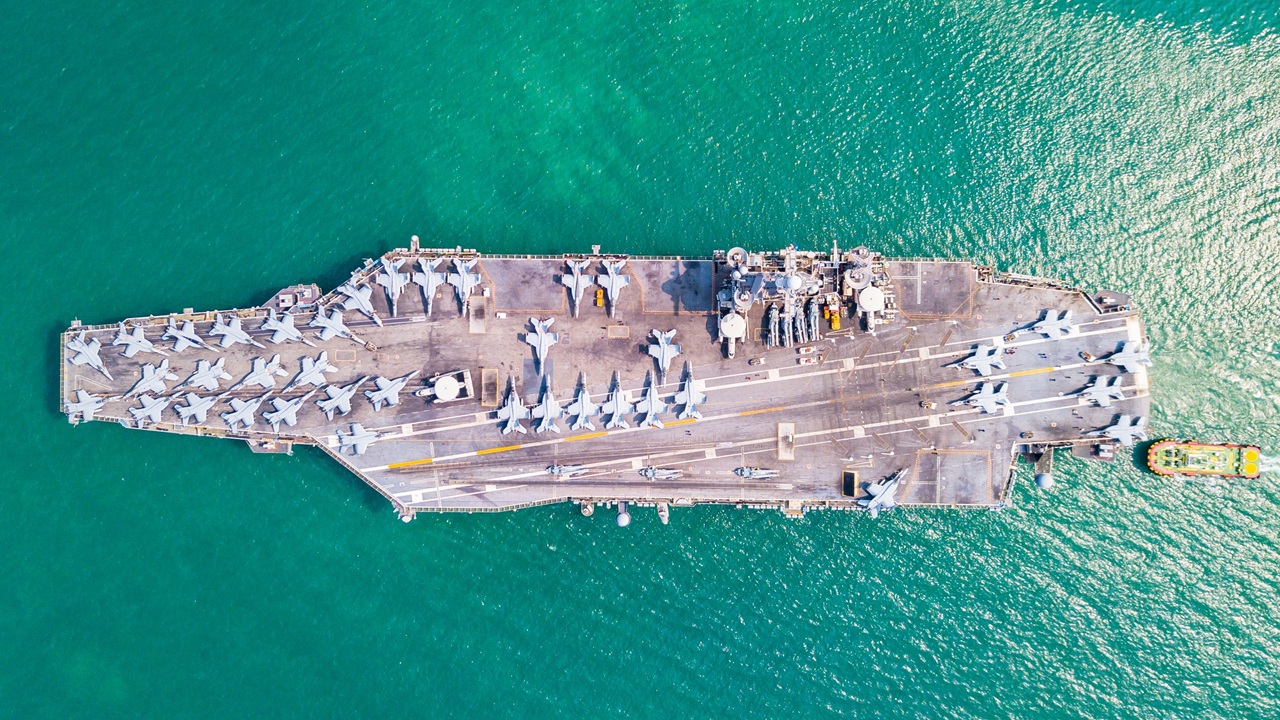
Like her sister ship, the USS Abraham Lincoln carries 60-70 aircraft. There are anywhere between 30-36 F/A-18E/F Super Hornets onboard and about 10-20 F-35Cs onboard. Five to seven EA-18G Growlers are also onboard.
How Carrier Airpower Breaks the Iranian Defense Model
The power of the carrier strike group is immense.
Last summer, the Trump administration demonstrated the way in which US military warplanes could penetrate Iranian airspace and launch at least some attacks against sensitive targets. Of course, there remains debate over the efficacy and thoroughness of those attacks.
But, if the US military, with assistance from Israeli intelligence, is keen to attack regime targets, they might have more look rather than a hardened military facility deep underground.
Of course, Iran has significant anti-ship ballistic missile capabilities and increasingly effective long-range strike systems that threaten even the safety of American carriers if they dare to get in range. But, during the 12-Day War, when the American carriers launched aircraft to support the B-2 Spirit stealth bombers, the US carrier stayed just out of the projected range of Iranian anti-ship capabilities.
What’s more, it wasn’t only planes that struck Iranian targets. The Navy saturated suspected Iranian nuclear weapons facilities with Tomahawk cruise missiles fired from submarines.
An aircraft carrier brings a sizable capability that drastically enhances the striking power and lethality of US forces in the region. Each carrier has an airwing that includes F-35C Lightning II fifth-generation warplanes, F/A-18 E/F Super Hornets, and the almighty EA-18G Growlers (for electronic warfare and destruction of enemy air defenses purposes).
Along with the carriers are a bevy of warships and submarines, many of which can pop off scores of Tomahawk cruise missiles.
While the Iranian anti-ship ballistic missile capability is not to be ignored, the carriers do bring with them an integrated air defense capability that traditionally does an effective job of protecting those maritime assets from anti-ship attacks. Further, the presence of multiple carriers allows for high-intensity flight operations all day, every day, meaning that their ability to penetrate Iranian airspace and harass the already embattled regime is great.
It is projected that the USS Abraham Lincoln will arrive in the CENTCOM AOR at some point this week. Once situated in the region, it is my assessment that President Trump will order those carriers to initiate sweeping airstrikes upon key regime targets.
Whatever Trump’s stated aims, it is clear that his actions—and the actions of the Israelis—are geared at regime change. Whether it leads to a desired outcome or simply kicks over a hornet’s nest that results in the destruction of Tel Aviv and/or Haifa along with key military bases, possibly even damage to at least one of the American carriers, remains to be seen.
But once the carriers later this week are fully in position, Trump will likely strike…and those strikes, unlike before, are unlikely to be limited or short.
Trump’s Ultimate Gamble: Overthrowing the Government in Iran
Trump, it seems, is betting his entire presidency on achieving that which his predecessors never could do for 47 years: destroy the Iranian regime. Alas, the enemy gets a vote…and the Iranian regime is still in power. This will be far harder than capturing Maduro in Venezuela was.
Regardless, Trump’s moves in the Middle East are not only about deterrence. He wants to finish a fight that’s been ongoing since 1979. His gamble might pay off. Then again, given that it’s the Middle East, it will likely destabilize an already unstable region (because of previous US military actions). Either way, once all the carriers are in place, there are no more off-ramps (other than Trump’s own mercurial nature).
And at that point, no one knows how this will ultimately end.
About the Author: Brandon J. Weichert
Brandon J. Weichert is a senior national security editor at The National Interest. Recently, Weichert became the host of The National Security Hour on America Outloud News and iHeartRadio, where he discusses national security policy every Wednesday at 8pm Eastern. Weichert hosts a companion book talk series on Rumble entitled “National Security Talk.” He is also a contributor at Popular Mechanics and has consulted regularly with various government institutions and private organizations on geopolitical issues. Weichert’s writings have appeared in multiple publications, including The Washington Times, National Review, The American Spectator, MSN, and the Asia Times. His books include Winning Space: How America Remains a Superpower, Biohacked: China’s Race to Control Life, and The Shadow War: Iran’s Quest for Supremacy. His newest book, A Disaster of Our Own Making: How the West Lost Ukraine is available for purchase wherever books are sold. He can be followed via Twitter @WeTheBrandon.
Image: Shutterstock / apiguide.
The post An American Aircraft Carrier Is Still on the Way to Iran appeared first on The National Interest.
Источник: nationalinterest.org