

«Данное сообщение (материал) создано и (или) распространено иностранным средством массовой информации, выполняющим функции иностранного агента, и (или) российским юридическим лицом, выполняющим функции иностранного агента»
 Topic: Air Warfare Blog Brand: The Buzz Region: Asia Tags: B-21 Raider, Bomber Aircraft, China, People’s Liberation Army Air Force, Sixth-Generation Aircraft, Stealth, and Xian H-20 How China’s H-20 Stealth Bomber Could Break America’s Pacific Defense January 18, 2026 By: Brandon J. Weichert
Share
Aircraft stealth technology is decades old, and China has demonstrated an innovative streak in its defense affairs—so Beijing’s claims about the H-20’s stealth capabilities should be taken seriously.
Chinese state media has proclaimed that the country’s mysterious H-20 long-range nuclear-capable stealth bomber is nearing its public unveiling. Of course, no timeline for the reveal has been given. But we are assured that it will be happening soon. The bomber is being billed as a rival to the United States Air Force’s B-21 Raider—and, from what little we know of its design, it appears at first blush as though there could be some merit to this claim.
America Should Take China’s H-20 Announcement Seriously
According to Warrior Maven, the vagueness of the announcement either denotes true progress or simply strategic messaging.
The H-20 “Xi’an” long-range nuclear-capable stealth bomber has been in development for some time. Ever since the dynamic US airstrikes on Iran’s suspected nuclear weapons facilities last summer during the 12-Day War—employing the older American long-range, nuclear-capable B-2 Spirit stealth bombers—China has been trying to convince the world that they, too, are dominant in stealth technology.
To be clear, the Chinese military is an advanced—and still advancing—military. China possesses the second-largest economy in the world in GDP terms. If measured in Purchasing Power Parity (PPP), it has had the largest economy since 2014. The country is now home to a robust, richly funded, and highly innovative (as well as imitative) high-tech sector.
Advanced military technology, and the ability to produce it at scale, is downstream from broader economic success. To believe that China is not nearing completion of indigenously made stealth bombers—a decades-old technology by now—at the same time it is pioneering quantum computing research and innovations in metamaterials, is wishful thinking.
The H-20 Xian vs. the B-21 Raider: A Rough Comparison
| Bomber Aircraft | B-21 Raider (USA) | H-20 Xian (China) |
| Year Introduced | Not yet introduced (anticipated 2026–2027) | Not yet introduced (anticipated “soon”) |
| Number Built | At least 3 prototypes (3 under construction, ~100 planned) | At least 1 prototype (~50 planned by 2035) |
| Length | ~16.5 m (55 ft) | 20 m (65 ft) |
| Wingspan | 40 m (132 ft) | 45 m (148 ft) |
| Weight (MTOW) | ~81,600 kg (180,000 lb) | ~200,000 kg (440,000 lb) |
| Engines | Two Pratt & Whitney PW9000 turbofan engines | Advanced domestic turbofan engines (likely related to China’s WS-10 variants) |
| Top Speed | ~1,000 km/h (620 mph) | ~1,175 km/h (730 mph) |
| Range | ~9,600 km (6,000 mi) | ~8,500–10,000 km (5,000–6,200 mi) |
| Service Ceiling | ~15,240 m (50,000 ft) | ~12,000–15,000 m (40,000–50,000 ft) |
| Loadout | Large internal bays for conventional and nuclear weapons; ~9,100 kg (20,000 lb) payload capacity | Large internal bays for conventional and nuclear weapons; 36,000–45,000 kg (~80,000–100,000 lb) payload capacity; advanced electronics |
| Aircrew | 2 | 2–4 |
China Is a Growing Threat to America’s Indo-Pacific Forces
The timing, of course, is interesting.
Not only are Chinese leaders pushing the viability of the H-20 following the B-2 strikes on Iran last summer, but they are saying that the planes will be demonstrated publicly in the wake of America’s successful raid in Caracas, Venezuela on January 3—a raid that resulted in the capture of Venezuelan leader Nicolas Maduro and his wife.
Between those two events, US military hardware was demonstrated and the rest of the world—China included—understood that the Americans still had some truly lethal capabilities.
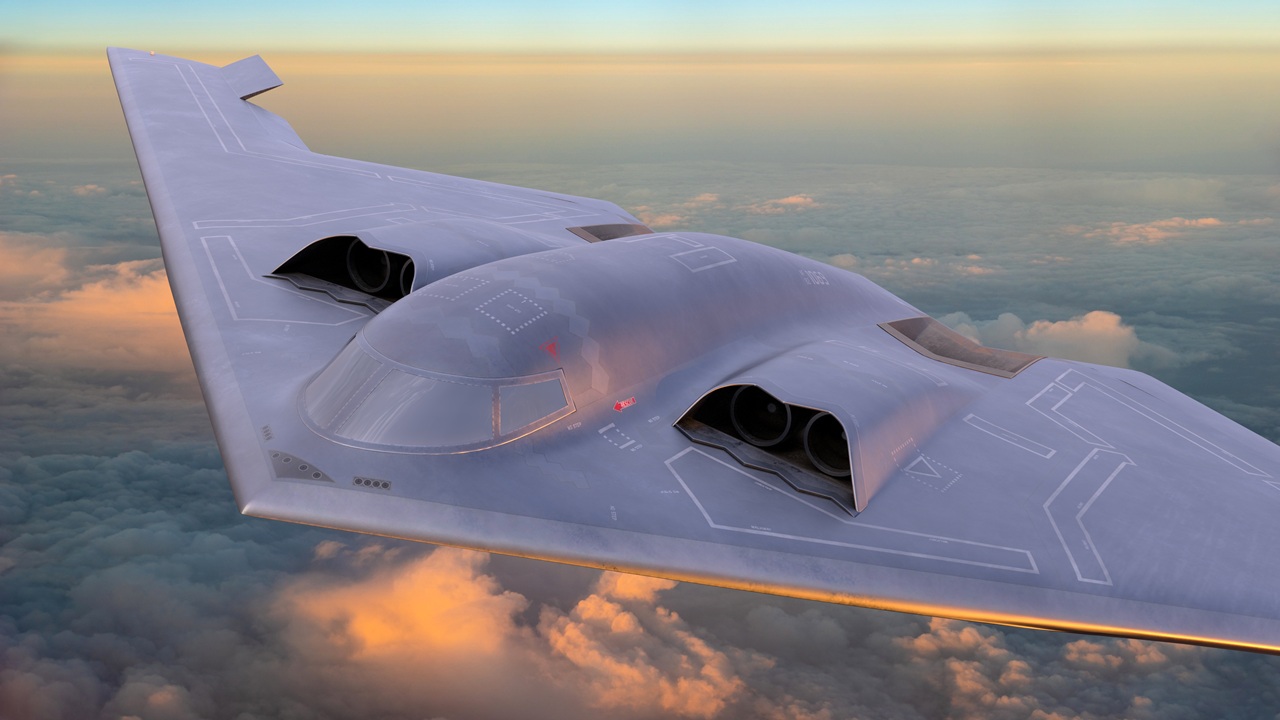
China’s H-20 is a flying-wing shape-design with stealth shaping nearly identical to US stealth bombers. A stealth bomber with H-20’s range could theoretically penetrate beyond the first and second island chains, with the ability to hit American strategic bases in Guam, Hawaii, and possibly even the continental United States (with midair refueling).
Most US-based analysts had assumed that these planes would not be ready until at least the 2030s. Yet the Chinese hints about these birds “coming soon,” indicates that they might be ready sooner.
Again, this should not surprise anyone. Considering China’s advanced technological base as well as its incredible mass production capacity, and the prospects of declining world order, it stands to reason that Beijing would want this capability as soon as possible. One can expect these planes to be hitting the unfriendly skies as quickly as Beijing can arrange it.
And should even a small number of the H-20s make it into service sooner than the 2030s, that will upend whatever is left of America’s deterrence in the Indo-Pacific, by conferring upon China deep strike capabilities against what were once considered to be safe US military facilities in the region.
To make matters worse for Washington, the H-20 is not only expected to carry nuclear gravity bombs, anti-ship missiles, and air-launched cruise missiles, but the Chinese are ensuring that their stealth bombers can carry hypersonic missiles. America is also testing hypersonic cruise missiles on their own stealth bombers.
Hypersonic Weapons Are the H-20’s Real Payload
But the Americans have greatly lagged both Russia and China—heck, they’ve fallen behind Iran in this case—in hypersonic weapons capabilities. Whereas the Americans are doing limited testing of this technology, China has working prototypes that they are perfecting (the Russians and Iranians have working arsenals of such weapons).
By pairing possible long-range stealth bombers, like the H-20 Xi’an, with hypersonic cruise missiles, the Chinese will be able to pummel US military facilities in the Second and Third Island Chains (or beyond) against which those key US military facilities lack any real defense.
The specifications of the H-20 are all unconfirmed. We can, however, deduce certain capabilities that the plane will feature—especially given the plane’s similarities to US long-range stealth bombers, like the B-2 or, more aptly, the newer B-21 Raider (which is still in development).
Both planes are highly capable, and both are still in development. For China, though, acquiring a long-range stealth bomber is a strategic gamechanger. It puts them at parity with the Americans.
And, with the H-20’s capacity to carry hypersonic weapons, the Chinese People’s Liberation Army Air Force (PLAAF) could seriously damage the US military in the Second Island Chain and beyond—a capacity that, save for nuclear weapons, the Chinese otherwise lack.
About the Author: Brandon J. Weichert
Brandon J. Weichert is a senior national security editor at The National Interest. Recently, Weichert became the host of The National Security Hour on America Outloud News and iHeartRadio, where he discusses national security policy every Wednesday at 8pm Eastern. Weichert hosts a companion book talk series on Rumble entitled “National Security Talk.” He is also a contributor at Popular Mechanics and has consulted regularly with various government institutions and private organizations on geopolitical issues. Weichert’s writings have appeared in multiple publications, including The Washington Times, National Review, The American Spectator, MSN, and the Asia Times. His books include Winning Space: How America Remains a Superpower, Biohacked: China’s Race to Control Life, and The Shadow War: Iran’s Quest for Supremacy. His newest book, A Disaster of Our Own Making: How the West Lost Ukraine is available for purchase wherever books are sold. He can be followed via Twitter @WeTheBrandon.
Image: Shutterstock / Mike Mareen.
The post How China’s H-20 Stealth Bomber Could Break America’s Pacific Defense appeared first on The National Interest.
Источник: nationalinterest.org