

«Данное сообщение (материал) создано и (или) распространено иностранным средством массовой информации, выполняющим функции иностранного агента, и (или) российским юридическим лицом, выполняющим функции иностранного агента»
 Topic: Naval Warfare Blog Brand: The Buzz Region: Americas Tags: Columbia-Class Submarines, North America, Nuclear Weapons, Ohio-class Submarines, Shipbuilding, Submarines, Undersea Warfare, United States, and US Navy Can the US Save Its Construction Timeline for the Columbia-Class Submarine? January 15, 2026 By: Brandon J. Weichert
Share
The Columbia-class submarine outstrips its predecessor, the Ohio class, in many ways—but falls short in one conspicuous one.
America’s naval shipyards are a mess—and have been for many years. US warships are not built in abundance, and the ones that are built often fall far behind schedule and go vastly over budget.
The Navy and America’s various large shipbuilders are trying its best to overcome these deficits—especially when it comes down to building enough of the all-important submarine fleet. After all, subs will be the tip of any spear in a potential war with China.
General Dynamics Has a New Floating Drydock
That’s why General Dynamics Electric Boat’s (GDEB) recent announcement that a new floating drydock—named Atlas—has arrived at its main shipyard in Groton, Connecticut, according to Naval News, an online trade publication. Atlas will support construction, launch, and sustainment operations for the United States Navy’s much-ballyhooed Columbia-class ballistic missile submarines (SSBNs), the next iteration of America’s potent nuclear-powered submarines.
The Navy designed the new Columbia-class submarines as a replacement for the aging Ohio-class nuclear submarines. These submarines are the backbone of America’s sea-based leg of its nuclear triad. Columbia-class submarines are massive subs, so big that the existing infrastructure of the shipyards simply cannot sustain their construction. That’s why Atlas, the temporary barge, was sent to the naval shipyards at Groton. The floating drydock will both ensure that the Columbia-class is built on time. One can anticipate that if the program succeeds in producing a usable submarine, these floating drydocks will become the norm.
Building the First Columbia-Class Sub Has Been Slow
Construction on the first ship of her class, the USS District of Columbia (SSBN-826), began years ago. The bow and major modules were constructed and assembled at various facilities, such as Newport News Shipbuilding. The Navy believes they will have the first delivery of the new Columbia-class by 2030, with ongoing progress on the block build.
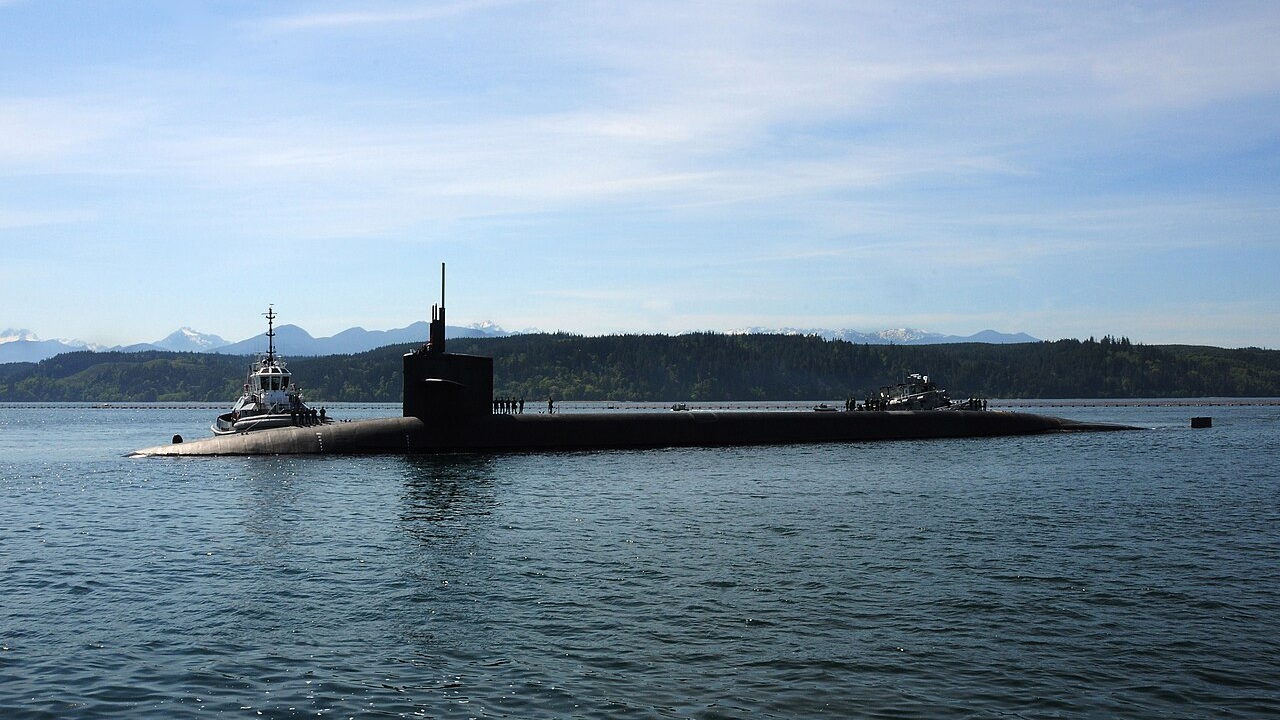
As for the importance of the Columbia-class, just let’s compare it to what exists in America’s fleet today. Specifically, the Ohio-class SSBN. Right now, the Ohio-class is the centerpiece of the US Navy’s sea-based nuclear deterrent. They conduct extended patrols carrying Trident II D5 ballistic missiles.
These boats have been upgraded repeatedly over the decades they have been in service to the US Navy fleet. In fact, as the Cold War diminished and the post-Cold War hangover took effect, the Navy ultimately converted four SSBNs into guided missile submarines (SSGNs).
That took the overall US Ohio-class SSBN fleet down to 14 (from 18). Each of these Ohio-class SSBNs carry 20 missiles per sub.
Built by General Dynamics Electric Boat Division, the Ohio-class SSBNs are the largest submarines ever built by the United States.
The Ohio Class vs. the Columbia Class: A Head-to-Head Comparison
| Submarine | Ohio Class | Columbia Class |
| Year Introduced | 1981 | Not yet introduced (expected 2031) |
| Number Built | 18 (14 in service) | 1 (12 ordered, 2 under construction) |
| Length | 560 ft (170 m) | 618 ft (188 m) |
| Beam (Width) | 42 ft (13 m) | 43 ft (13.1 m) |
| Displacement | 18,450 long tons submerged | 20,810 long tons submerged |
| Propulsion | One General Electric S8G pressurized water reactor | Nuclear reactor (unspecified) |
| Top Speed | ~20 knots (23 mph, 37 km/h) | Unknown; likely ~20 knots (23 mph, 37 km/h) |
| Range | Unlimited | Unlimited |
| Armaments | 24 Trident D5 Submarine-Launched Ballistic Missiles (SLBMs); four Mk 48 torpedo tubes for self-defense | 16 Trident II D5 Submarine-Launched Ballistic Missiles (SLBMs); four Mk 48 torpedo tubes for self-defense |
| Crew | 155 (15 officers, 140 enlisted) | ~155 |
Why Does the Columbia-Class Sub Carry Fewer Nuclear Weapons?
Dangerously, the Navy made a strategic decision during the design phase of the new Columbia-class to pare down the number of nuclear weapons they will carry onboard. Whereas the old Ohio-class carries 24 missiles, the Columbia-class will carry only 16. This was a decision made out of a desire for a leaner, more cost-effective deterrent force wherein stealth and a better reactor that never needs refueling on the Columbia-class will purportedly give the new SSBN advantages the old Ohio-class lacked.
Moreover, the Navy was forced to comply with the Obama administration’s New START Treaty, which reduced the number of nukes an SSBN could carry. Interestingly, the New START Treaty is set to expire in February, and neither the United States nor Russia has expressed much interest in prolonging it. Still, this is what the Navy has committed to—and the Navy is convinced that the Columbia-class is superior to the Ohio-class.
Toward that end, the new Atlas floating drydock will give a massive enhancement for Electric Boat’s aging infrastructure. With the new infrastructure, the shipyard could have a seriously modern system to support the critical rollout and lifecycle support of the future American submarine fleet.
About the Author: Brandon J. Weichert
Brandon J. Weichert is a senior national security editor at The National Interest. Recently, Weichert became the host of The National Security Hour on America Outloud News and iHeartRadio, where he discusses national security policy every Wednesday at 8pm Eastern. Weichert hosts a companion book talk series on Rumble entitled “National Security Talk.” He is also a contributor at Popular Mechanics and has consulted regularly with various government institutions and private organizations on geopolitical issues. Weichert’s writings have appeared in multiple publications, including The Washington Times, National Review, The American Spectator, MSN, and the Asia Times. His books include Winning Space: How America Remains a Superpower, Biohacked: China’s Race to Control Life, and The Shadow War: Iran’s Quest for Supremacy. His newest book, A Disaster of Our Own Making: How the West Lost Ukraine is available for purchase wherever books are sold. He can be followed via Twitter @WeTheBrandon.
Image: Wikimedia Commons.
The post Can the US Save Its Construction Timeline for the Columbia-Class Submarine? appeared first on The National Interest.
Источник: nationalinterest.org