

«Данное сообщение (материал) создано и (или) распространено иностранным средством массовой информации, выполняющим функции иностранного агента, и (или) российским юридическим лицом, выполняющим функции иностранного агента»
 Topic: Naval Warfare Blog Brand: The Buzz Region: Asia Tags: Arms Sales, China, Military Exercises, Silver, Taiwan, and United States How America’s $11 Billion Arms Sale to Taiwan Provoked China January 8, 2026 By: Brandon J. Weichert
Share
The United States should seek to offer concessions to China in order to avoid a war over Taiwan—starting with a clarification of the One China Policy.
In the wake of the successful American raid against Nicolas Maduro’s compound in Caracas, Venezuela—capturing the socialist dictator and whisking him away to New York for trial on drug trafficking charges, and leaving the remainder of the country to an uncertain fate—the world seems to have forgotten the highly provocative actions taken by the Chinese military around Taiwan the week before.
China Is Clearly Preparing to Blockade Taiwan
Dubbed “Justice Mission 2025,” China conducted its largest-ever military drills encircling Taiwan. Justice Mission 2025 involved more than 30 Chinese ships and 130 planes, and included live-fire drills along with a simulated blockade of the island. To American, Taiwanese, and Japanese audiences, this was a warning shot from Beijing about any potential Taiwan independence move.
The drills lasted from December 29-30, and were the sixth round of serious wargames conducted by China around Taiwan since former US Speaker of the House Nancy Pelosi (D-CA) traveled to Taiwan in 2022.
Justice Mission 2025 covered a significant area that was much closer to Taiwan’s main island than any of those previous exercises since 2022. China even created seven practice zones for their live-fire and blockade tests in Taiwan’s territorial waters.
During the drills, China simulated a blockade of major Taiwanese ports, like Keelung and Kaohsiung. They deployed wild new technologies into the area, too, such as humanoid robots, mini-drones, and their now famous robotic dogs.
China’s Exercises Followed a US Arms Sale to Taiwan
For its part, Taiwan condemned the move, calling Beijing “the biggest destroyer of peace” in East Asia. The Taiwanese Armed Forces were placed on their highest military alert, while performing their own rapid, counter-drills just across from the Chinese military drills.
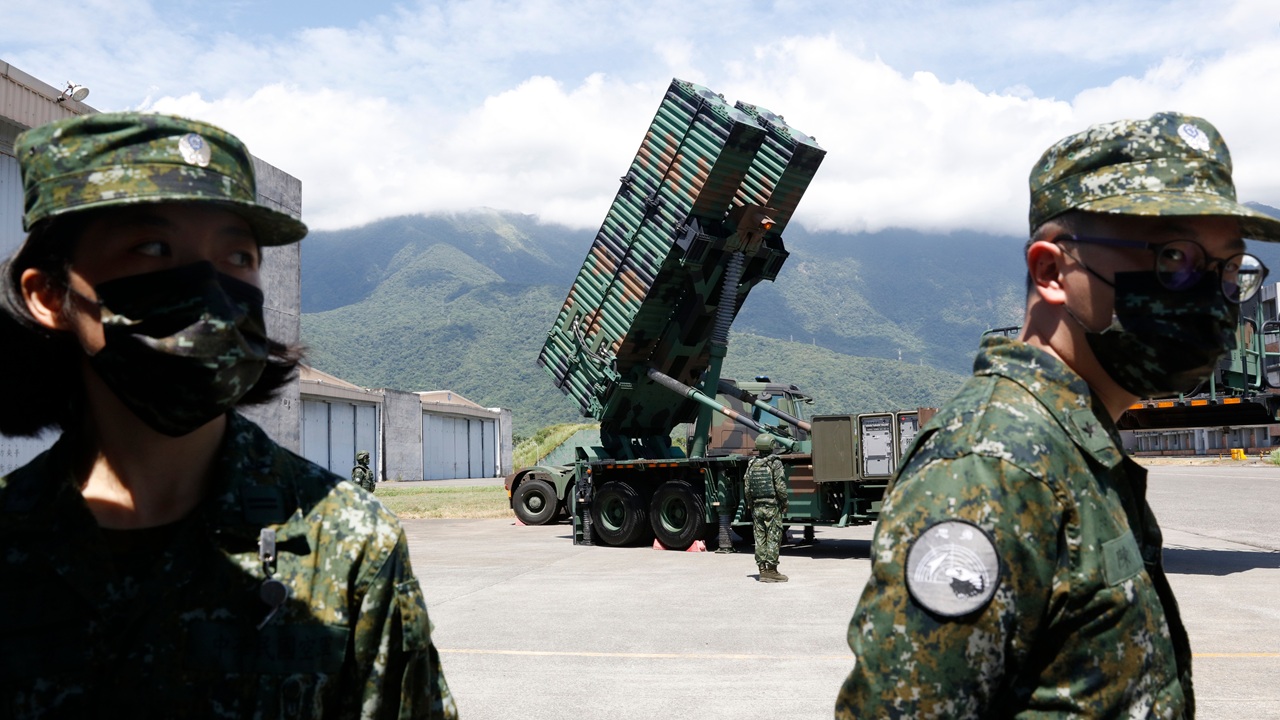
These Taiwanese drills specifically showcased some of the island’s newest American weapons, notably the US-made HIMARS rocket system. Indeed, those HIMARS and many other advanced American systems were, ironically, the direct cause of the stunning Chinese military drills—not the response to them.
At the close of 2025, the Trump administration authorized a massive military aid package, altogether worth $11 billion, to Taiwan. Far from a typical aid package, the latest package included advanced weapons like the HIMARS rocket launcher, ATACMS missiles, M109A7 howitzers, Altius drones, Javelin/TOW missiles, and other important tactical software. The aim was to bolster the island’s self-defense and asymmetrical warfare capabilities—building up Taiwan’s “porcupine” defense strategy. In essence, the US and their allies plan to flood Taiwan with so many lethal weapons that it becomes an impenetrable island fortress—and Chinese planners contemplating how to take over the island become convinced that the extreme pain it can inflict on the People’s Liberation Army is not worth the cost.
But the Trump administration’s decision to sell such a large amount of these systems to Taiwan was an affront to China’s leadership, which views Taiwan as little more than a breakaway province. That is why Beijing acted so brazenly and went so over-the-top with its military exercises.
China’s Real Counterstrike Was Economic, Not Military
It wasn’t only the Justice Mission 2025 that Beijing engaged in. It also did something frightening to the rest of the world: it imposed strict export controls over its massive quantities of silver. That move destabilized the global commodities market, sent American firms like JPMorgan into a tailspin, and sent ripples throughout all the industries (such as the high-tech sector) that rely on silver for key components of their products.
China didn’t do this on whim. After all, it had just recently settled the trade war with President Trump with a clear win. The only reason that China did the military exercises around Taiwan and the silver restriction play was out of frustration and embarrassment over the American decision to load Taiwan with such massive, advanced American weapons. It doesn’t matter if the Chinese are truly threatened by the weapons. What matters is that the Trump administration embarrassed them publicly. It was a classic faux pas.
Interestingly, Trump’s new National Security Strategy (NSS) memo spent an inordinate amount of time doing two things in its 33 pages. The first was to explain why the United States was pivoting away from the world and returning to manage its own hemisphere. The second was to water down more aggressive language related to China.
While the document does not completely neuter the previous hawkish approach to China that Washington has held, the NSS makes clear that the Trump administration will instead focus intently on a cooperative framework based upon trading relations with China rather than military competition with Beijing.
Frankly, the United States in its present condition, cannot afford a war—especially one with China. Instead, Washington should be looking to stabilize relations with China rather than antagonizing them.
China today enjoys a dominant stake in key commodities sectors (rare earth minerals, gold, and silver, for instance). The damage that Beijing can do to the American economy due to this stranglehold cannot be overstated.
And if the United States and China truly went to war over Taiwan, no one would win…least of all the Taiwanese. While unpopular, there is a framework that has existed since the United States and China first began engaging each other on the diplomatic stage during the Nixon administration.
That is, of course, the One China Policy.
The One China Policy Is Unpleasant—but Necessary
This is a most unpleasant policy for the United States. But, with China having gained so many advantages on the world stage, the alternative at this point to that program is conflict.
The Trump administration and President Xi Jinping should issue a new joint communique in which they reaffirm the commitment to the One China Policy, under which the United States recognizes that there is but one government of China—the current one in Beijing, unlike the ambiguous stance the US government currently takes—while remaining aloof about Taiwan’s final status.
So long as the United States does not continue antagonizing and embarrassing China over the issue of Taiwan, it is likely that Beijing will also seek to restore this basic principle in Sino-American affairs.
It would be preferable, too, compared to what fate would befall Taiwan should the Americans press the independence factor too hard. That is especially in the wake of how little leverage the Americans possess over China in the Indo-Pacific.
Whether China’s military could effectively take the island is very much in question.
Yet, why would any responsible leader in Washington, Taipei, or Beijing seek to find out?
The time to defeat China’s rise has come and gone. China has risen. It is now the second-largest economy in GDP terms and the largest in purchasing power parity (PPP) terms.
Beijing is the dominant player in the Indo-Pacific (at least in the First Island Chain). Let’s work with Beijing and Taipei to avert a devastating war and find areas of mutual benefit via geoeconomics. We don’t have to be best friends. But we can all work to ensure that our competitive urges are channeled into the economic domain, as opposed to the military one.
About the Author: Brandon J. Weichert
Brandon J. Weichert is a senior national security editor at The National Interest. Recently, Weichert became the host of The National Security Hour on America Outloud News and iHeartRadio, where he discusses national security policy every Wednesday at 8pm Eastern. Weichert hosts a companion book talk series on Rumble entitled “National Security Talk.” He is also a contributor at Popular Mechanics and has consulted regularly with various government institutions and private organizations on geopolitical issues. Weichert’s writings have appeared in multiple publications, including The Washington Times, National Review, The American Spectator, MSN, and the Asia Times. His books include Winning Space: How America Remains a Superpower, Biohacked: China’s Race to Control Life, and The Shadow War: Iran’s Quest for Supremacy. His newest book, A Disaster of Our Own Making: How the West Lost Ukraine is available for purchase wherever books are sold. He can be followed via Twitter @WeTheBrandon.
Image: Shutterstock / jamesonwu1972.
The post How America’s $11 Billion Arms Sale to Taiwan Provoked China appeared first on The National Interest.
Источник: nationalinterest.org