

«Данное сообщение (материал) создано и (или) распространено иностранным средством массовой информации, выполняющим функции иностранного агента, и (или) российским юридическим лицом, выполняющим функции иностранного агента»
 Topic: Space Blog Brand: The Buzz Region: Asia Tags: China, Mining, Moon, Robots, and United States China’s Robotic Insect Army Is Coming for the Moon January 8, 2026 By: Brandon J. Weichert
__label has-kicker-variant»>Share
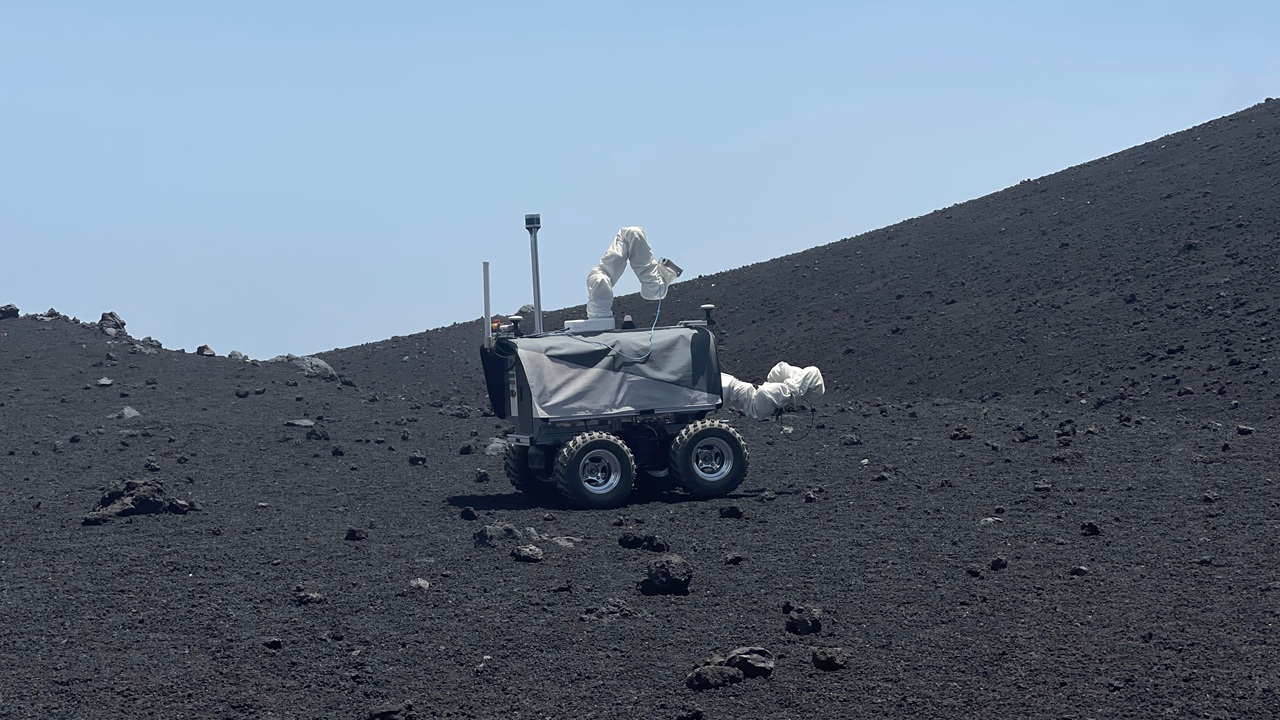
China has successfully developed a moon robot with both limbs and wheels—presumably to be used to extract resources from the lunar surface.
China continues innovating interesting technologies that will help Beijing to win in the new space race—specifically, the race for control over the moon. For China, getting to the moon is not just a matter of national prestige. They care little for merely beating their geopolitical rivals to the surface of Earth’s sole natural satellite and simply sticking a flag there for posterity.
Beijing has far grander plans…and a strategy for lunar dominance.
China Wants to Mine the Moon. Here’s How That Works.
The Chinese have already successfully gone where no American has gone before with their equipment: the so-called “dark side” of the moon. While there, China’s rover collected critical data on the makeup of the soil on the side of the moon that never sees sunlight.
What they found has encouraged China’s strategic thinkers to continue their long march toward lunar dominance.
Not only is the moon the very ultimate strategic high ground for the Earth-Moon System, meaning that whichever nation on Earth rises to dominate the territory there will have unprecedented dominance on the lower orbital planes and the Earth itself below.
But, beyond the strategic implications, are the far more interesting economic opportunities that exist in lunar mining. These are opportunities that the Chinese plan on exploiting with wanton abandon in the coming decade or so.
As such, a team of visionaries at the China University of Mining and Technology (CUMT) have developed a new robotic exploration vehicle that will make long-term exploitation and development of the moon’s natural resources easier.
Meet China’s Lunar Insectoid Robot
For this mission, China has built a six-legged, biometric “insect” lunar mining robot.
The Chinese contraption uses insect-like claws for anchoring in the regolith and employs a combination of wheels and claws for more versatile movement on the lunar surface, to be used for any eventual asteroid mining missions.
This unique robot will enable more efficient geological surveying and mineral environments in rugged, low-gravity environments such as the moon. CUMT scientists describe their freakish creation as a machine that resembles a panoply of animals on the Earth. From woodpeckers to insects, CUMT’s scientists have employed the principles of origami to ensure successful mining exploration missions in the harsh environments of the moon and beyond.
One of the biggest obstacles CUMT scientists had to overcome was the issue of physical stability in microgravity. That’s where the array of claw-spine hardware comes into play. It prevents physical draft in the zero-g environment while the machine is pummeling the regolith of the moon, searching for mineable resources.
Its unique fusion of wheels and insect-like limbs further allows for Chinese lunar geologists to explore the many craters of the moon in their quest for mineable, profitable natural resources there.
Of course, as with many new Chinese technologies, the system has never been tested in the real world. But Professor Liu Xinhua, the leader of the CUMT team developing the system, has successfully experimented with the machine in simulated lunar environments. According to reports, Professor Liu’s CUMT team tested the rover in simulated soil conditions and found that it could move with little difficulty.
This Frankenstein’s monster-like, chimeric robot is more than another rover. It’s the first step toward China taking the lunar resources for itself—just as it has conquered the South China Sea (SCS) and is attempting to dominate the Gulf of Thailand.
So make no mistake: unless the United States starts streamlining its lunar mission profile, and embraces a new Apollo-like mission for returning to and holding key territories on the moon, then it will permanently lose the strategic high ground to the Chinese. Machines like this insectoid rover are one of many examples of how serious China is in both dominating the strategic high ground and monopolizing its resources.
About the Author: Brandon J. Weichert
Brandon J. Weichert is a senior national security editor at The National Interest. Recently, Weichert became the host of The National Security Hour on America Outloud News and iHeartRadio, where he discusses national security policy every Wednesday at 8pm Eastern. Weichert hosts a companion book talk series on Rumble entitled “National Security Talk.” He is also a contributor at Popular Mechanics and has consulted regularly with various government institutions and private organizations on geopolitical issues. Weichert’s writings have appeared in multiple publications, including The Washington Times, National Review, The American Spectator, MSN, and the Asia Times. His books include Winning Space: How America Remains a Superpower, Biohacked: China’s Race to Control Life, and The Shadow War: Iran’s Quest for Supremacy. His newest book, A Disaster of Our Own Making: How the West Lost Ukraine is available for purchase wherever books are sold. He can be followed via Twitter @WeTheBrandon.
Image: Shutterstock / wiktoriaex.
The post China’s Robotic Insect Army Is Coming for the Moon appeared first on The National Interest.
Источник: nationalinterest.org