

«Данное сообщение (материал) создано и (или) распространено иностранным средством массовой информации, выполняющим функции иностранного агента, и (или) российским юридическим лицом, выполняющим функции иностранного агента»
 Topic: Air Warfare, and Military Administration Blog Brand: The Buzz Region: Americas Tags: Air National Guard, Aircraft, Department of Defense (DoD), National Guard, North America, and United States Why Does America Have an “Air National Guard”? January 4, 2026 By: Harrison Kass
Share
Though one might imagine the “Air National Guard” as a secondary force using refurbished equipment to defend America’s borders, it regularly deploys to conflict zones with modern fighter jets.
The Air National Guard (ANG) is often perceived as a reserve or secondary force to the US Air Force. In reality, the ANG performs a vital national security function, close to home, without the headlines or fanfare associated with the Air Force. Sitting at the crossroads of territorial defense, global operations, and civil response, the ANG is a versatile component of US air power.
How the “Air National Guard” Works
The Air National Guard has two distinct mission sets: state and federal. The state mission, under the state’s respective governor, pertains to disaster response, homeland emergencies, etc. while the federal mission, under the president, pertains to combat deployments, air defense etc. Unlike the Air Force Reserve, the ANG is geographically tied to specific states, with deep integration to local infrastructure and communities. ANG personnel are mixed between full-time professionals and part-time airmen, often with civilian jobs in addition to their ANG responsibilities.
The core mission of the ANG is to provide the backbone of US homeland air sovereignty. The ANG performs NORAD alert missions, with 24/7 quick-reaction alert (QRA) aircraft, and the interception of unidentified or non-compliant aircraft. Indeed, most continental US fighter alert sites are ANG-operated rather than active-duty Air Force. This reflects a post-9/11 shift, in which the ANG became the permanent air defense force over US cities; fighters on alert over population centers is now entirely normal.
The Air National Guard Flies the Same Planes as the Air Force
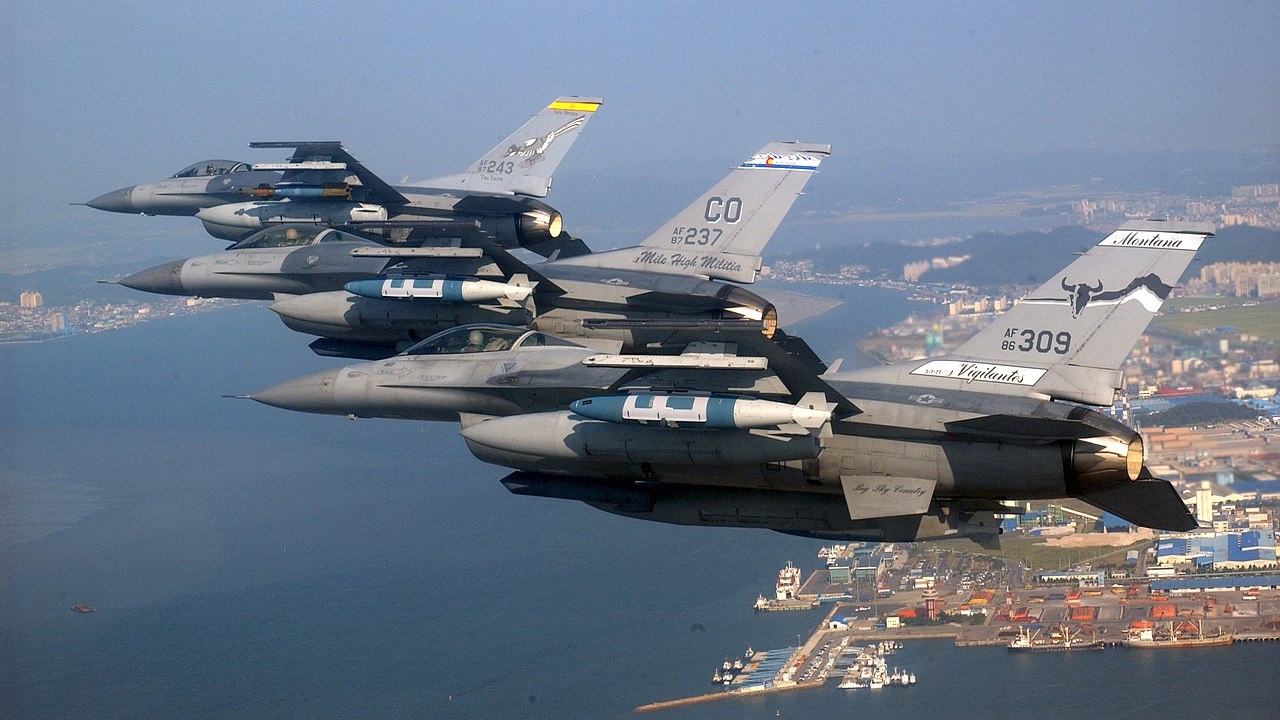
From the name, one might expect that the Air National Guard is primarily a reserve force that flies secondary aircraft, while the best equipment is reserved for the Air Force. In fact, the ANG flies front-line platforms, not outdated hand-me-downs. Example aircraft include the F-15C/D Eagle, the F-15EX Eagle II, the F-16 Fighting Falcon, the F-35A Lightning II, the KC-135 and KC-46 tankers, and a variety of ISR aircraft. The ANG units are often integrated with new aircraft rapidly due to stable basing and a stable of experienced pilots. The ANG also makes heavy use of datalinks, radar networks, and integrated air defense systems tied into NORAD.
In short, the ANG is not a backwater, but a technologically sophisticated and modern fighting force. Moreover, while “Air National Guard” implies strictly homeland defense, the ANG’s front-line platforms are routinely deployed overseas to Iraq, Afghanistan, Syria, Europe, and the Indo-Pacific. In many campaigns, ANG aircraft flew a disproportionate share of sorties relative to their size. Tanker and airlift ANG units are especially critical, offering global mobility and sustained operations. And as active-duty units rotate in and out, the ANG often provides continuity.
Stateside, the ANG is tasked with domestic and civil response missions, including disaster relief, wildfire response, hurricane evacuation, search and rescue, and medical airlift. The ANG is typically capable of operating seamlessly with state emergency agencies or FEMA or National Guard ground units—an integration that active-duty forces cannot replicate.
Why the Air National Guard Goes Underappreciated
Strategically, the ANG offers cost efficiency, delivering combat capability at lower long-term costs. And because ANG resources are distributed in bases across the states, they enhance vulnerability, because they make the force structure less vulnerable to single-point failure. In a doomsday scenario against Russia or China, the ANG would anchor homeland defense while active-duty forces would deploy forward.
Still, the ANG remains under-appreciated—likely because it has no permanent overseas bases and fewer high-profile missions. It operates quietly, domestically, and defensively in a context where success often looks as though nothing happened at all.
About the Author: Harrison Kass
Harrison Kass is a senior defense and national security writer at The National Interest. Kass is an attorney and former political candidate who joined the US Air Force as a pilot trainee before being medically discharged. He focuses on military strategy, aerospace, and global security affairs. He holds a JD from the University of Oregon and a master’s in Global Journalism and International Relations from NYU.
Image: Wikimedia Commons.
The post Why Does America Have an “Air National Guard”? appeared first on The National Interest.
Источник: nationalinterest.org