

«Данное сообщение (материал) создано и (или) распространено иностранным средством массовой информации, выполняющим функции иностранного агента, и (или) российским юридическим лицом, выполняющим функции иностранного агента»
 Topic: Air Warfare Blog Brand: The Buzz Region: Asia Tags: Air Defense, China, Directed Energy Weapon, Lasers, Oman, SkyShield, and United States China’s Laser Leap: Beijing Is Quietly Winning the Next Arms Race January 3, 2026 By: Brandon J. Weichert
Share
China seems to have outpaced the United States and its allies in the development of directed energy weapons—as seen by its recent exports to the Middle East.
China refuses to slow its attempts to compete on the global arms market, specifically the arms export market to the Global South. Beijing has long fancied itself as the steward of the Developing World—dating back to the Bandung Conference in the 1960s, when Mao’s representatives attempted to bridge the gap between traditional communism and revolutionary communism.
China’s Long Game in the Global South
While China’s elite today have largely abandoned the pretense of communism, the fact remains that they have fashioned themselves into being defenders of the Global South—and many countries in that part of the world view them as such.
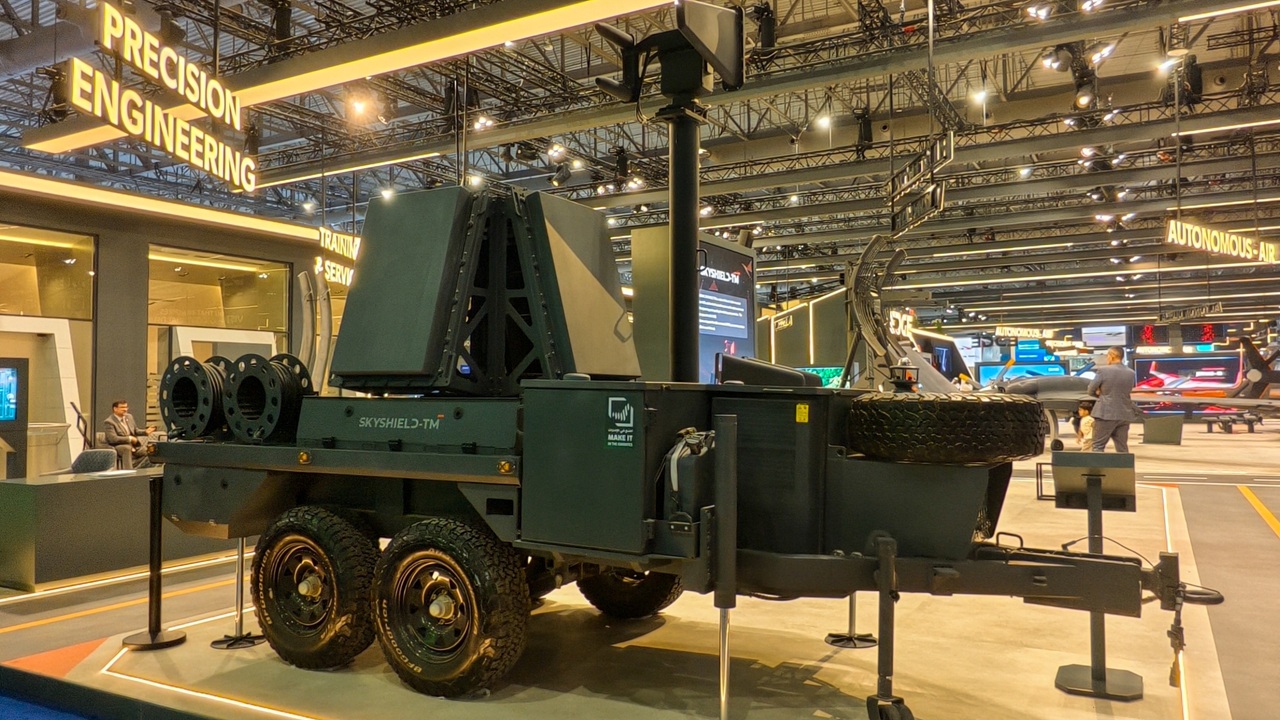
Recently, photos appeared on social media showcasing a Chinese-made integrated counter-drone and laser air defense system launched out of a port in Oman. According to Defence Blog, an online industry publication, the system being shown in those photos was China’s SkyShield, developed by China Electronics Technology Group Corporation (CETC). SkyShield’s most notable feature is its directed-energy laser weapon, which has been dubbed “Silent Hunter” and is meant for hard-kill engagements against drones and other low-altitude threats.
Until recently, laser weapons were the stuff of science fiction. A handful of countries tested prototypes, but these were still in early stages and prone to failures. The Americans, despite having invested gobs of tax dollars over many years, effectively abandoned their directed-energy weapon (DEW) programs. Japan is one of the countries leading the world in this new technology domain. Israel, with its Iron Beam air defense system, is another.
But China has come out of nowhere not only with an investment into the development of DEWs. Beijing has apparently gotten its own laser weapons to work—at least when it comes to knocking drones out of the sky. Lasers are increasingly desired as a potential frontline weapon due to their low cost per shot and line-of-sight engagement capabilities.
These are especially useful against targets like drones. Consider that in every instance of counter-drone action in Ukraine, the defender employing counter-drone defenses at close range—usually a gun—expends vast amounts of ammunition just to hit one target.
A laser is limited by things like power and weather conditions. But in a close-quarter engagement, it is predicted to be far better for the survival of the defender than bullets or missiles.
As for which power was going to be receiving this new, advanced (albeit untested in combat) system, there is no confirmation. In recent years, though, China has moved quickly into the role of being a major arms seller to multiple parties in the turbulent Middle East. So these laser anti-drone systems could be to any number of states—from the United Arab Emirates to Qatar to Saudi Arabia to, possibly, even the Islamic Republic of Iran.
Lasers Spell the End of Ammunition Economics
At a time when few countries are able to make their DEWs work—let alone to mass-produce them—China appears to have achieved both. That the Middle East is the likeliest place where these laser weapons will next be tested will help the Chinese learn how effective the system is against drone and missile swarms. It could also generate major increased proliferation of Chinese DEWs in the region over time.
This isn’t the only laser weapon that the Chinese have been experimenting with. The photos from Oman of China’s new SkyShield system is a unique look into China’s clearly dynamic developmental arc of DEW air defense systems. Its presence in the Gulf region shows how serious that the region’s powers are taking air defense in the wake of drone swarms becoming the new normal—in the aftermath of the American bombings of suspected nuclear weapons sites in Iran, Iran’s (and its allies’) relentless bombings of Israel, and Israel’s retaliatory airstrikes throughout the region.
Under these conditions, cheap air defenses that are innovative and could overwhelm the kind of devastation certain powers are planning to inflict on the Middle East might be enough to stop the fighting before it begins. We are at the dawn of the DEW revolution. But by all indications, China is already lightyears ahead.
About the Author: Brandon J. Weichert
Brandon J. Weichert is a senior national security editor at The National Interest. Recently, Weichert became the host of The National Security Hour on America Outloud News and iHeartRadio, where he discusses national security policy every Wednesday at 8pm Eastern. Weichert hosts a companion book talk series on Rumble entitled “National Security Talk.” He is also a contributor at Popular Mechanics and has consulted regularly with various government institutions and private organizations on geopolitical issues. Weichert’s writings have appeared in multiple publications, including The Washington Times, National Review, The American Spectator, MSN, and the Asia Times. His books include Winning Space: How America Remains a Superpower, Biohacked: China’s Race to Control Life, and The Shadow War: Iran’s Quest for Supremacy. His newest book, A Disaster of Our Own Making: How the West Lost Ukraine is available for purchase wherever books are sold. He can be followed via Twitter @WeTheBrandon.
Image: Shutterstock / Allora Empire Art.
The post China’s Laser Leap: Beijing Is Quietly Winning the Next Arms Race appeared first on The National Interest.
Источник: nationalinterest.org