

«Данное сообщение (материал) создано и (или) распространено иностранным средством массовой информации, выполняющим функции иностранного агента, и (или) российским юридическим лицом, выполняющим функции иностранного агента»
 Topic: Naval Warfare Blog Brand: The Buzz Region: Americas Tags: Civil War, Confederacy, Naval Blockade, Ships, and Texas “Cottonclads” at Dawn: How the Confederacy Snatched Galveston from the Union January 1, 2026 By: Brandon J. Weichert
Share
On New Year’s Day 1863, the Confederacy managed to break the Union blockade choking its ports by capturing Galveston, Texas.
New Year’s Day 1863 was a seminal day in the American Civil War. That was the day that Confederate forces, which had been under an intense Union Navy blockade since early in the war, managed to break that blockade and secure for themselves the crucial Texas port of Galveston.
Because of that unexpected victory by Confederate forces at the Battle of Galveston on January 1, 1863, the Civil War was prolonged as the Confederate economy could limp on, because the South could continue selling its essential commodity of cotton to the outside world via the port of Galveston.
The “Anaconda Plan”: Lincoln’s Chokehold on the South
Once the Civil War began in earnest, President Abraham Lincoln authorized the Anaconda Plan that was proposed by Union General Winfield Scott. The goal of the Anaconda Strategy was to totally deprive the Confederate States of America—the secessionists—from having access to the wider world.
Scott’s idea was to constrict the South with a massive, regional blockade, the way an anaconda snake constricts its prey before devouring them.
Union forces moved to blockade both the Atlantic and Gulf coasts while challenging the Confederates for control of the Mississippi River. In fact, the Union sent forces down to New Orleans, intending to capture it to better split the Confederacy in half.
Over time, the blockade crippled Southern exports, notably cotton, and deprived Richmond of access to foreign goods. Ultimately, in 1863, the capture of Vicksburg by Union forces under the command of Gen. Ulysses S. Grant ensured Union dominance over the Mississippi River.
At Galveston, the Confederacy Punched a Hole in the Union Blockade
But, at the start of 1863, the Confederates were able to puncture a critical hole in the Union’s blockade at Galveston.
Maj. Gen. John B. Magruder led Confederate forces on the day of the battle. Magruder had his army launch a surprise attack on Union forces on New Year’s Day. The attack occurred simultaneously across the sea and on land.
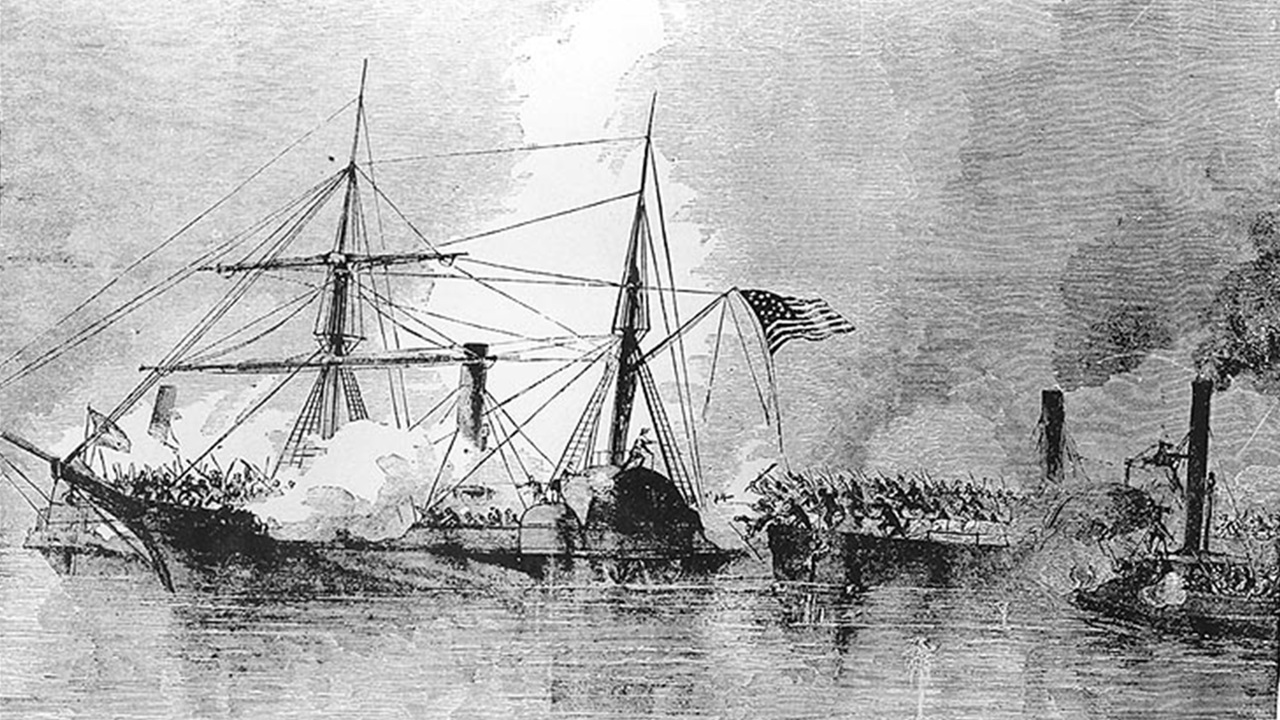
Two steamers—dubbed “cottonclads,” the CS Bayou City and CS Neptune—were part of the South’s innovative naval tactics on the day of battle. These two steam-powered riverboats were wrapped in layers upon layers of cotton bales, which provided a unique protective shell around the two riverboats, defending them against cannonballs and giving them time to ram the Union warships that were participating in the blockade at Galveston.
The cotton protected the hull of the converted riverboats, while the critical machinery was protected by timbers as well as cotton. Meanwhile, the cottonclads had cannons and Rebel sharpshooters positioned behind more cotton for protection from enemy fire.
In classic naval warfare tradition, once the Confederate ships got near the US Navy warships, they then deployed boarding planks to send Confederate Marines over to the US warships and utilized rams to further degrade the warfighting capabilities of Union warships.
General Magruder’s Gamble Paid Off
Ultimately, the Neptune was sunk (perhaps fitting, considering its name), but the Bayou City successfully rammed and even captured the USS Harriet Lane. Meanwhile, Confederate troops stormed Galveston, forcing the surrender of all Union forces within the city.
In a war that was quickly turning against the Confederacy, the Battle of Galveston was a bright spot and a major morale boost for the embattled Southerners. Plus, it ensured that at least some of the Confederate cotton would make it to the world markets—and the money earned from selling that commodity abroad could continue funding what was becoming the flagging Confederate war effort.
The Confederacy’s Battle of the Bulge?
The stunning victory at Galveston, employing truly innovative tactics and utilizing relatively new technologies, like steam engines on ships to pierce the Union’s blockade of the Gulf Coast, will be remembered as a shocking moment in the Civil War.
That Gen. Magruder chose to attack on New Year’s Day, when clearly the US forces were more relaxed, shows how innovative the underdog Confederates could be.
But the South’s fate was sealed by 1863. Like the German offensive at the Battle of the Bulge in World War II, the Confederate seizure of Galveston was one of the last breaths of the South before its inevitable defeat by the larger, wealthier, more populated, and more technologically advanced Union.
Still, the Battle of Galveston was a high point for the Confederacy that remains an important battle for study of the Civil War.
About the Author: Brandon J. Weichert
Brandon J. Weichert is a senior national security editor at The National Interest. Recently, Weichert became the host of The National Security Hour on America Outloud News and iHeartRadio, where he discusses national security policy every Wednesday at 8pm Eastern. Weichert hosts a companion book talk series on Rumble entitled “National Security Talk.” He is also a contributor at Popular Mechanics and has consulted regularly with various government institutions and private organizations on geopolitical issues. Weichert’s writings have appeared in multiple publications, including The Washington Times, National Review, The American Spectator, MSN, and the Asia Times. His books include Winning Space: How America Remains a Superpower, Biohacked: China’s Race to Control Life, and The Shadow War: Iran’s Quest for Supremacy. His newest book, A Disaster of Our Own Making: How the West Lost Ukraine is available for purchase wherever books are sold. He can be followed via Twitter @WeTheBrandon.
Image: Wikimedia Commons.
The post “Cottonclads” at Dawn: How the Confederacy Snatched Galveston from the Union appeared first on The National Interest.
Источник: nationalinterest.org