

«Данное сообщение (материал) создано и (или) распространено иностранным средством массовой информации, выполняющим функции иностранного агента, и (или) российским юридическим лицом, выполняющим функции иностранного агента»
 Topic: Air Warfare Blog Brand: The Buzz Region: Europe Tags: Aircraft, Eastern Europe, Fighter Jets, Russia, Su-27 Flanker, Sukhoi Su-30, Sukhoi Su-33, and Sukhoi Su-35 Why the Flanker Fights Like No Western Jet January 1, 2026 By: Harrison Kass
Share
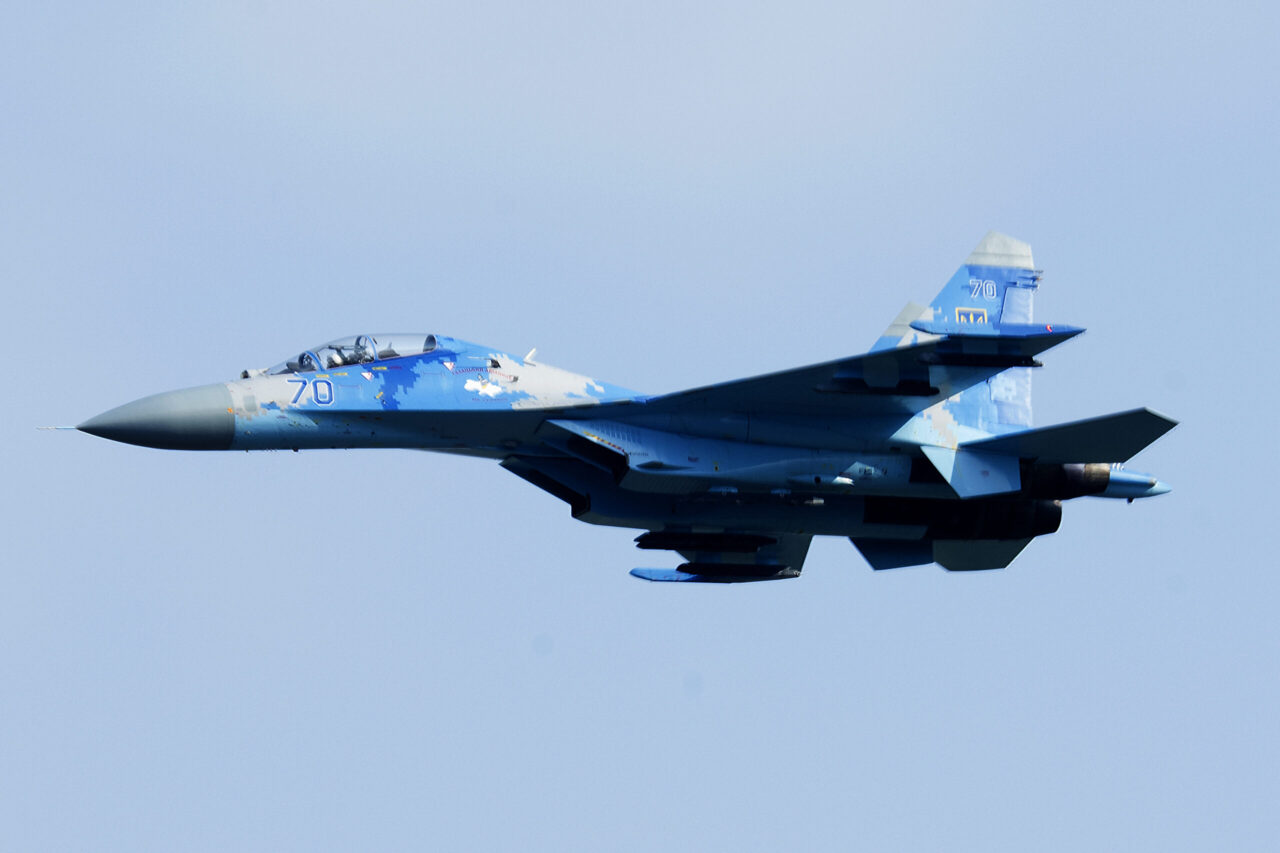
The Flanker platform is famous for airshow maneuvers, but those maneuvers are not merely for entertainment value; they allow the Flanker to win engagements within visual range.
The Russian “Flanker” aircraft is not one aircraft, but a family of fighters derived from the original Su-27. Introduced as the Soviet Union’s answer to the American F-15 Eagle, the Su-27 prioritizes range, payload, and maneuverability—reflecting a distinctive Russian approach to air combat.
History of the Su-27 Flanker
Developed in the 1970s and 1980s amid intensive Cold War weapons competition, the Su-27 draws on lessons learned during Vietnam, namely, the need for longer-range fighters, better sensors, and improved dogfighting capability. The Su-27 was designed to defend vast Soviet airspace rather than operate from dense overseas bases and entered service in the mid-1980s.
The core design philosophy emphasizes size, endurance, and aerodynamic authority. The large, blended wing-body generates lift from the fuselage. The twin-engine configuration offers redundancy and high thrust. The Su-27 was optimized for fighting at long range with missiles and at close range with maneuverability. The aircraft was not optimized for stealth, but instead for kinematics and physical presence.
The Flanker Has Multiple Variants
The Flanker family has multiple variants. The Su-27 is the original air superiority fighter; the Su-30 is a two-seat multirole variant, a workhorse that has been extremely successful in the export market; the Su-33 is the naval, carrier-capable version; and the Su-35 is the heavily upgraded fourth-generation-plus Flanker. Also, the Flanker has been licensed to China, which built the J-11 and J-16 derivatives. Over time, the Flanker evolved from a pure interceptor to a multirole platform, following trends in aerospace development that favored versatility.
From a technical perspective, the Flanker has a high thrust-to-weight ratio thanks to two powerful engines. The large internal fuel capacity gives the Flanker a long combat radius. And powerful radar and infrared (IR) search and track give the Flanker enhanced situational awareness. The large weapon payload, including long-range radar missiles and high-off-boresight IR missiles, makes the Flanker a lethal platform. And advanced control surfaces enable high-angle-of-attack flight, and in later variants, post-stall maneuvers.
The Flanker is exceptional at low-speed and high-alpha handling. The platform is famous for airshow maneuvers, but those maneuvers are not merely for entertainment value; they allow the Flanker to win engagements within visual range. The aircraft does have weaknesses, however, like a large radar cross-section, making it easy to detect in defended airspace, and high energy bleed if mishandled.
About the Su-27 Flanker
- Year Introduced: 1985
- Number Built: ~680 (Su-27 variants, excluding derivatives)
- Length: 71 ft 10 in (21.9 m)
- Wingspan: 48 ft 3 in (14.7 m)
- Weight (MTOW): ~73,850 lb (33,500 kg)
- Engines: Two Saturn AL-31F turbofans (≈27,500 lbf / 122 kN thrust each with afterburner)
- Top Speed: ~1,553 mph (2,500 km/h) ≈ Mach 2.35
- Range: ~2,200 mi (3,530 km) ferry; ~850 mi (1,370 km) combat radius
- Service Ceiling: ~59,000 ft (18,000 m)
- Loadout: One 30mm GSh-30-1 cannon; up to ~17,600 lb (8,000 kg) of air-to-air missiles on 10 hardpoints
- Aircrew: 1
Operational Applications
The Flanker family’s mission profile has expanded to include air superiority, escort, long-range patrol, and strike. The aircraft can operate effectively without heavy tanker support or dense overseas basing—thanks to the large internal fuel storage and long combat radius. This is ideal for defending large geographic areas and projecting presence.
Strategically, the Flanker is the backbone of Russian tactical aviation. The Flanker is also the backbone of Russia’s export strategy, with client states including India, China, Venezuela, Algeria, and Indonesia. Clients buy the Flanker for the platform’s long reach and credible air deterrence—and because she’s cheaper than some Western options.
Of course, as air power effectiveness becomes increasingly reliant on stealth and sensors, the Flanker’s authority will be degraded; she is still dangerous, but not uncontested, a relic in certain respects, emphasizing reach over subtlety and maneuverability over invisibility. Flankers will remain relevant, however, based on their sheer numbers and their intimidation factor.
About the Author: Harrison Kass
Harrison Kass is a senior defense and national security writer at The National Interest. Kass is an attorney and former political candidate who joined the US Air Force as a pilot trainee before being medically discharged. He focuses on military strategy, aerospace, and global security affairs. He holds a JD from the University of Oregon and a master’s in Global Journalism and International Relations from NYU.
Image: DVIDS.
The post Why the Flanker Fights Like No Western Jet appeared first on The National Interest.
Источник: nationalinterest.org